There are trips you take to see things. And there are trips you take to understand something — about yourself, about what you want, about what's left when you remove the calendar, the responsibilities and the habits of thirty years. The Camino de Santiago belongs to the second category. It's not a tourist trip. It's not a sports hike, even if the blisters and the knee pain are very real. It's a walking journey of several weeks across Spain, alone or with strangers who become something else as the stages go by, toward a cathedral in the northwestern corner of the European continent — and what happens during this trip isn't what you'd planned.
Quebecers have been doing the Camino in growing numbers since the 2010s. Paulo Coelho's book (The Pilgrimage, 1987) opened a first wave. The film The Way (Martin Sheen, 2010) triggered a second one. And since then, word of mouth does the rest — people who come back from the Camino don't talk about what they saw. They talk about what they felt. About the conversation with a stranger in the rain in the Pyrenees that lasted 8 hours and that they remember word for word. About the pain on the 12th day that disappeared on the 13th day in some inexplicable way. About the arrival in Santiago after 800 km on foot — and the disorientation that follows, because the Camino is over but something has changed and you don't yet know what.
This guide covers everything a Quebecer needs to know to do the Camino — the available routes, how to prepare physically, what to put in the pack (and especially what not to put in it), the stages of the Camino Francés, the realistic budget in CAD, and the questions no one asks but everyone has.
1. What is the Camino de Santiago?
The history — 1,200 years of pilgrimage
The Camino de Santiago (the Way of Saint James) is one of the three great Christian pilgrimages of the Middle Ages — along with Rome (Via Francigena) and Jerusalem. Its destination is the cathedral of Santiago de Compostela in Galicia (northwestern Spain), where the presumed relics of the apostle Saint James the Greater (Santiago in Spanish) have been kept since the 9th century. In the 12th century, hundreds of thousands of pilgrims crossed Europe each year to reach Compostela — roads, hospitals, monasteries and cathedrals were built along their path. The system of albergues (pilgrim hostels) that walkers use today is directly inherited from this medieval infrastructure.
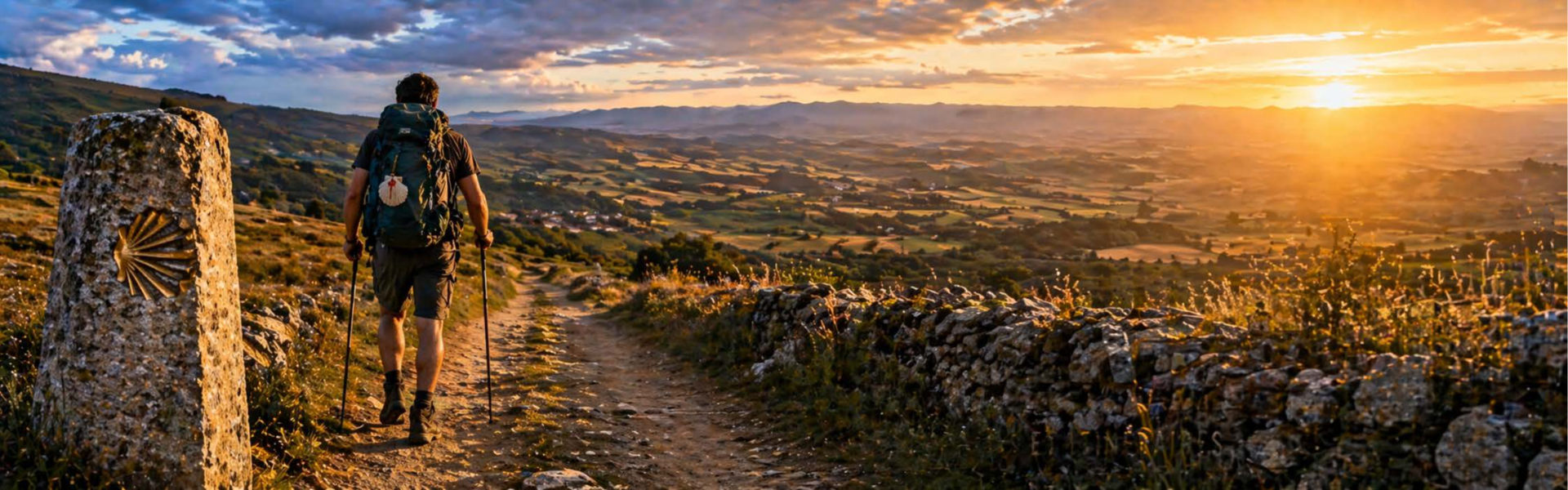
Today, the Camino goes well beyond religious pilgrimage. Of the 350,000 people who arrive in Santiago each year (in 2023 — a steadily rising figure), fewer than a third declare a purely religious motivation. The others walk for personal reasons, athletic ones, spiritual without being religious, or simply because they're looking for something they can't yet name. The scallop shell (la vieira) — the symbol of the Camino that pilgrims wear on their backpacks — has been on these roads for so long that it now belongs to all human motivations, not only Catholic ones.
The Compostela — the pilgrim's diploma
The Compostela is a Latin certificate issued by the cathedral of Santiago to pilgrims who have walked at least 100 km on foot (or 200 km by bicycle) to Santiago, and who have had their credencial (pilgrim passport) stamped in the albergues, churches and cafés along the route. This document isn't a tourist gimmick — it has been issued since the 12th century and represents, for many pilgrims, the most concrete and most meaning-laden achievement of the entire trip. Seeing your name in Latin on a parchment signed by the cathedral, after 800 km on foot, is an experience no one talks about without emotion.
2. The Camino routes — which one to choose?
| Route | Starting point | Distance | Duration | Difficulty | Why choose it |
|---|---|---|---|---|---|
| Camino Francés (the most famous) | Saint-Jean-Pied-de-Port (France) | 780 km | 30 – 35 days | ⭐⭐⭐ Moderate | The classic route — the busiest, the best marked, with the most infrastructure. The densest pilgrim community. Ideal for a first Camino. |
| Camino Portugués (from Porto) | Porto (Portugal) | 270 km | 12 – 15 days | ⭐⭐ Easy | The most popular for pilgrims pressed for time. Departs from Porto (direct flights from Montreal). Atlantic coast and medieval villages. Gentler than the Francés. Less crowded. |
| Camino Portugués Coastal | Porto or Viana do Castelo | 280 km | 13 – 16 days | ⭐⭐ Easy | Follows the Portuguese Atlantic coast — beaches, fishermen, faro and lighthouses. The most visually beautiful of the Portuguese routes. Recommended in summer. |
| Camino del Norte (Basque coast) | Irun (Spanish Basque Country) | 820 km | 35 – 40 days | ⭐⭐⭐⭐ Difficult | Follows the north coast of Spain — Bilbao, San Sebastián, Santander. Less crowded, wilder, more mountainous. For experienced walkers. |
| Camino Primitivo (the first) | Oviedo (Asturias) | 320 km | 13 – 16 days | ⭐⭐⭐⭐ Difficult | The first historical Camino (King Alfonso II, 829 AD). Through the mountains of Asturias. Wild, lightly travelled, very physical. For seasoned walkers. |
| Vía de la Plata (Silver Way) | Seville (Andalusia) | 1,000 km | 40 – 50 days | ⭐⭐⭐ Moderate | The longest and least crowded Camino. Through southern Spain and the Meseta. Very little infrastructure in some sections. An experience of intense solitude. |
| Camino Inglés (English Way) | Ferrol or A Coruña (Galicia) | 75 – 120 km | 3 – 6 days | ⭐ Easy | The route of English pilgrims who arrived by boat. The shortest way to earn the Compostela (100 km minimum). Perfect for testing the Camino in a few days. |
| Camino Finisterre (extension) | Santiago → Finisterre | 90 km | 3 – 4 days | ⭐⭐ Easy | The extension after Santiago — out to the end of the earth (Finisterre), the ancient end of the Roman world on the Atlantic. Many pilgrims burn their shoes on the beach there. |
3. The Camino Francés — stages from Saint-Jean to Santiago
The Camino Francés is classically divided into 33 stages of 20 to 30 km — but every pilgrim adapts the pace. Here are the main stages with their characteristics.
| Stage | From → To | Distance | Elevation | What you need to know |
|---|---|---|---|---|
| 1 | Saint-Jean-Pied-de-Port → Roncesvalles | 25 km | +1,450 m / -700 m | The most difficult stage of the Camino — crossing the Pyrenees. Start at 200 m, pass at 1,450 m. Unpredictable weather. In case of snow or fog, alternative via Valcarlos (flat, 24 km). First night at the Roncesvalles albergue — a 12th-century monastery. |
| 2 | Roncesvalles → Zubiri | 22 km | +250 m / -700 m | Gradual descent through the beech forests of Navarre. The first blisters generally appear at this stage — not even 48 h of walking yet. |
| 3 | Zubiri → Pamplona | 21 km | +190 m / -250 m | Arrival in Pamplona — the city of the encierros (running of the bulls). The Plaza del Castillo, the citadel and the old town deserve half a day. The first big city on the Camino. |
| 4-5 | Pamplona → Logroño | 2 stages, 93 km | Rolling | Alto del Perdón (780 m) — the hill of metal pilgrim silhouettes, the most famous photo on the Camino. La Rioja begins — vineyards on both sides of the path. First Rioja tasting mandatory in Logroño. |
| 6-8 | Logroño → Burgos | 3 stages, 119 km | Flat to rolling | The crossing of La Rioja — vineyards, medieval villages (Nájera, Santo Domingo de la Calzada). The cathedral of Burgos (Gothic, 13th century) — the most beautiful on the Camino. A psychologically difficult stage: you're at the 1/4 mark. |
| 9-14 | Burgos → León | 5 stages, 183 km | Flat — La Meseta | The Meseta — the plateau of Castile, arid, vast, treeless. Pilgrims either love or hate the Meseta. This is where the Camino becomes meditative: nothing to see for hours, just the path and your own thoughts. The most psychologically transformative stage. |
| 15-17 | León → O Cebreiro | 3 stages, 121 km | +600 m to O Cebreiro | The crossing into Galicia — O Cebreiro at 1,330 m, often in the clouds. The vegetation changes completely: from the aridity of Castile to the green oak and chestnut forests of Galicia. The hórreos (corn granaries on stilts) appear. So does the rain. |
| 18-22 | O Cebreiro → Santiago | 5 stages, 155 km | Generally descending | The last 155 km — green and humid Galicia. Sarria (115 km from Santiago) is the last official starting point to earn the Compostela. The pilgrim community gets denser. The last 20 km from Monte do Gozo are the most intense — you start to hear the bagpipes of Santiago. |
| Arrival | Santiago de Compostela | The Praza do Obradoiro | — | The square in front of the cathedral — the moment everyone talks about and that no one can really describe in advance. The pilgrim's mass at noon (with the giant censer — the Botafumeiro — hanging from the vault). The line for the Compostela. The pilgrim's dinner that evening. |
4. Physical preparation — what isn't said enough
The truth about the fitness required
The Camino isn't reserved for athletes. People in their 70s do it every year. Overweight people do it. People who had never walked more than 5 km in a row before leaving do it. It's not a question of exceptional fitness — it's a question of progressive preparation and managing your daily effort. The Camino isn't difficult because a stage is technically hard (with the exception of the Pyrenees on day one). It's difficult because you do it for 30 days in a row — and it's the accumulation, not the intensity, that tests bodies and minds.
- Start your preparation 3 to 6 months before departure: walk progressively, first 5 km, then 10, then 15, then 20 km in a single day. The goal isn't speed — it's endurance and the resilience of feet and joints.
- Walk with your pack and your shoes: the most important preparation is walking with the same pack (correctly loaded) and the same shoes you'll use on the Camino. Blisters that show up in preparation are blisters that won't show up in Portugal.
- Train downhill: climbs tire the muscles, descents wreck the knees and toes. The first day of the Camino Francés (the descent from Roncesvalles) does more damage to the knees than the climb up the Pyrenees. Train specifically on descents.
- Don't neglect stretching: 10 minutes of calf, hamstring and quad stretching in the evening, every day during preparation and on the Camino, significantly reduces overuse injuries.
- See your doctor: if you have a history of knee, hip or foot problems, see a doctor or physiotherapist before committing to 780 km. Some conditions are incompatible with prolonged walking — better to know before Saint-Jean.
The most common injuries and how to avoid them
- Blisters: the leading cause of early dropout. To avoid them: merino wool socks (no cotton — cotton holds moisture), shoes well broken in before departure (at least 200 km in preparation), changing socks at mid-stage in hot weather. Treatment: pierce with a sterilized needle, don't remove the skin, apply Compeed or Vaseline, keep going.
- Knee pain (iliotibial band syndrome): the second cause of stopping. Generally appears after the first week, on descents. Prevention: walking poles (reduce knee pressure by 25 to 30 %), preventive anti-inflammatories on stages with heavy descent, quadriceps strengthening in preparation.
- Achilles tendinitis: heat from the inflammation, pain in the heel when getting up in the morning. Treatment: ice, anti-inflammatories, 1 to 2 days of rest. The temptation to keep going often costs an extra week of rest.
- Lower back pain: often linked to a pack that's too heavy. The absolute rule of the Camino: the pack must not exceed 10 % of your body weight. For a 70 kg person, that's 7 kg maximum — empty pack included.
5. Equipment — what to bring and especially what not to bring
The golden rule of the Camino is simple and universally known: a pack that's too heavy ruins a Camino. The temptation to "plan for every situation" produces 15 to 20 kg packs that destroy knees, shoulders and morale within the first week. Here is the complete recommended equipment — with the approximate weight of each category.
| Category | Target weight | Details and recommendations |
|---|---|---|
| Backpack (45 to 55 L) | 1.2 – 1.8 kg | Osprey Atmos AG, Gregory Baltoro or equivalent. Must have an adjustable suspension system and a hip belt that transfers 70-80 % of the weight to the hips. Buy at a specialty store and have it fitted by an expert. |
| Light trail or hiking shoes | 600 – 900 g per pair | No heavy mountain boots — the Camino terrain is mostly tracks and paved road. Light trail shoes (Salomon, Hoka, Brooks) are better suited. Tested over 200+ km before departure. Half a size larger for descents (toes swell after 20 km). |
| Light sandals (Birkenstock, Crocs) | 200 – 400 g | Indispensable for evenings at the albergue, foot care, rest days. They let your feet recover after the day's walking. Crocs are the choice of 40 % of Camino pilgrims — not the prettiest, but the most practical. |
| Socks (3 pairs of merino wool) | 200 g | Darn Tough, Smartwool, Icebreaker — the brands that hold up. Merino wool is antibacterial, regulates temperature and resists odour. Change at mid-stage in summer. Avoid cotton at all costs. |
| Clothing (synthetic or merino) | 800 g – 1 kg | 2 quick-dry t-shirts, 1 convertible (zip-off) pants, 1 pair of shorts, 2 merino underwear, 1 light fleece. No jeans, no cotton — everything must dry overnight on the albergue's clothesline. |
| Light waterproof jacket | 200 – 400 g | Galicia (the last 200 km) is one of the rainiest regions in Europe. No poncho — it flies in the wind and doesn't cover the pack. A light Gore-Tex jacket that packs into its own pocket. |
| Telescopic walking poles | 400 – 600 g per pair | Leki, Black Diamond or Black Diamond — poles reduce knee pressure by 25-30 % on descents. Indispensable for fragile knees. Learn the correct technique (wrist in the strap, push back) before departure. |
| Light sleeping bag (liner) | 200 – 400 g | Albergues provide beds with mattresses — not always sheets. A light silk or cotton sleeping bag liner is enough. No need for a full sleeping bag — too heavy and too hot in summer. |
| First-aid kit | 200 – 300 g | Compeed (anti-blister — bring lots), sterilized needles, ibuprofen, acetaminophen, bandages, antiseptic, sunscreen (SPF 50), anti-diarrheal, antihistamine. The most important pharmacy on the Camino is in your pack. |
| Credencial (pilgrim's passport) | None | Buy before departure (Quebec associations, Notre-Dame Church in Montreal, or online) or in Saint-Jean-Pied-de-Port on day one. Get it stamped in every albergue, church and café. Required to earn the Compostela. |
| Phone + 10,000 mAh power bank | 300 – 400 g | The Camino de Santiago app (free) is the GPS of the Camino — all stages, albergues with real-time availability, bars, pharmacies. The power bank provides 2 to 3 full charges. |
| TOTAL full pack with water and food | 7 – 10 kg max. | Water (1 to 2 L depending on the stage) and the day's snack add to this. Beyond 10 kg, you run a serious risk of injury. If you can't get under 10 kg, use the bag transfer service (Jacotrans, TransExpreso) — they carry your pack from albergue to albergue for 5 to 8 € per stage. |
6. Albergues — sleeping on the Camino
Types of accommodation
- Municipal albergue: the cheapest (5 to 12 €/night), run by the municipality or an association. Dorms of 20 to 80 beds, shared bathrooms, sometimes a kitchen available. First come, first served — no reservations possible. The most authentic form of the Camino.
- Private albergue: more expensive (12 to 25 €/night) but bookable online. Smaller dorms (6 to 12 beds), sometimes bunks with individual curtains, better-quality bathrooms, equipped kitchen. The comfort difference matters significantly after 10 days of walking.
- Private room in an albergue (chambre doble): many albergues offer private rooms with 1 or 2 beds. 30 to 60 €/night. The option for pilgrims who want the Camino experience without the shared dorm.
- Casa rural / Pension / Hotel: in the larger cities (Pamplona, Logroño, Burgos, León, Santiago), local pensions and hotels welcome pilgrims with their credencial. 40 to 100 €/night. Useful for rest days or recovery stages.
Albergue rules
- Silence is required from 10 p.m. — pilgrims often get up at 6 a.m. and the rustling of sleeping bags at 11 p.m. creates tension.
- Cold or lukewarm showers: normal. The temperature of the shower water is the most unpredictable variable on the Camino. Get used to it.
- Beds are assigned on arrival — pick a bottom bunk if you're the type who gets up at night. The bottom bunk also avoids waking your neighbour at 5:30 a.m. when you climb down.
- The shoe rule: leave your shoes at the entrance of the albergue (in the designated area) — albergue dorms already smell enough without adding hiking shoes to it.
7. When to go — the Camino calendar
| Period | Weather & crowds | Albergues & reservations | Our advice |
|---|---|---|---|
| January – Feb | 🟢 Cold, very few pilgrims | Always space, no reservations | For solitary types and seekers of silence. Some bars and albergues closed. An intense contemplative experience. Rainy Galicia. |
| March – Apr | 🟢 Mild, moderate crowds | Reservations recommended in Galicia | Excellent period. Spring in Spain — flowering fields, pleasant temperatures. Holy Week (Easter) very crowded — to avoid. |
| May – Jun | ⭐ Ideal — mild and uncrowded | Reservations advised from Sarria | The best period according to most pilgrims. Before the Spanish heatwave, after the Easter crowds. Wildflowers all along the route. The last 100 km not yet overrun. |
| July – Aug | 🔴 Hot (35 °C+), very crowded | Reservations required 30 days in advance | High season — albergues are full, stages crowded, the Meseta heat is exhausting. The last 100 km (Sarria → Santiago) are packed with short-distance walkers. To avoid if possible. |
| September – Oct | ⭐ Excellent — cool and beautiful | Reservations advised in Galicia | The second-best period. La Rioja's grape harvest in September. Less hot than summer. Extraordinary autumn light in Galicia. September pilgrims are often the most interesting. |
| November – Dec | 🟢 Cool, very few pilgrims | No reservations needed | For pilgrims seeking solitude and austerity. Some albergues closed. The Pyrenees can be snowed in by December (Valcarlos alternative). Christmas in Santiago — the lit cathedral is extraordinary. |
8. The budget — Camino Francés from Quebec in CAD
| Expense | Pilgrim budget (albergues) | Comfort budget (private rooms) |
|---|---|---|
| Flight Montreal → Paris or Bayonne (return) | $800 – $1,400 | $800 – $1,400 |
| Train Paris → Saint-Jean-Pied-de-Port | $50 – $100 | $50 – $100 |
| Accommodation (33 nights) | $500 – $900 | $1,500 – $2,500 |
| Meals (menu del peregrino + groceries) | $700 – $1,100 | $1,000 – $1,800 |
| Equipment (if buying before departure) | $400 – $900 | $400 – $900 |
| Bag transfer (optional, partial) | — | $200 – $400 |
| Local transport (occasional taxi, bus) | $80 – $150 | $150 – $300 |
| Santiago → return airport | $50 – $100 | $50 – $100 |
| Travel insurance (mandatory) | $100 – $200 | $100 – $200 |
| Contingency / rest days / souvenirs | $150 – $300 | $300 – $600 |
| ESTIMATED TOTAL (33 days) | $2,830 – $5,150 | $4,550 – $8,300 |
9. The Camino community — the people you meet
This is the part of the Camino no one can really describe in advance and that everyone mentions first when they come back. The Camino creates an instant, intense community among people who would never have met otherwise. A Korean doctor. A retired German doing his 7th Camino. A 58-year-old Quebec woman walking alone for the first time in her life since her divorce. A 22-year-old Brazilian student. An Australian family with two teenagers.
What creates this community isn't nationality, age or religion. It's the shared road. The fact of crossing the same Pyrenees on the same day, treating the same blisters in the same hallway, ordering the same menu del peregrino at the same bar in Burgos. The conversations that start while walking on the path and last for hours are often the most honest you've had in years — because the physical effort and the anonymity of the road strip away the usual social filters. Pilgrims who met on the Camino meet again in Santiago years later, or visit each other in their home countries. The Camino creates lasting friendships.
The concept of the Camino "family"
On the Camino Francés, pilgrims who leave on similar dates often end up in the same albergues for days, then weeks. A group forms organically — not planned, not decided, just the same walking pace and the same departure times. This Camino family is one of the most unexpected and most precious experiences of the path. It can break apart and reform several times — someone takes a rest day, or speeds up, or slows down — but the presence of those familiar faces in an unfamiliar albergue is a comfort that those who walked alone appreciate at its true value.
10. What guidebooks don't say — honestly
The hard moments — they exist
The Camino isn't a non-stop postcard ad. There are days of pouring rain in Galicia where shoes have been soaked since 6 a.m. and the remaining 25 km feel impossible. There are dorms where someone snores at a volume that defies physics. There's the Meseta — that 5-day Castilian plateau of flat, arid walking under a blazing sun where some pilgrims crack, take a bus, and feel a shame disproportionate to what it actually means (nothing — everyone has their own limits). There's the loneliness of bad days, distinct from the chosen solitude of good days.
What's said less often: those hard moments are often the most important on the Camino. The pilgrim who crosses the Meseta without taking a bus, not because they're stronger than the others but because they decided to stay with themselves even when it's uncomfortable — that pilgrim arrives in Santiago with something different from someone who had good weather for 33 days. Resistance is part of the journey.
Arrival in Santiago — and what comes after
Arrival in Santiago is emotionally intense for nearly every pilgrim — but not always in the way you imagined. Some cry. Others are surprised not to cry. Some feel an explosive joy. Others feel an emptiness — the Camino is over, and they don't yet know what to do with that. Post-Camino disorientation is a phenomenon well documented by the psychologists who study the experience: after 33 days of a simple structure (walk, eat, sleep), the return to the complexity of ordinary life can be destabilizing.
The pilgrims' mass at noon in the Santiago cathedral — the Misa del Peregrino — is an extraordinary moment regardless of your relationship to religion. The Botafumeiro, the giant 80 kg censer suspended from the cathedral's vault by ropes and pulleys, swinging from transept to transept above the heads of pilgrims and releasing clouds of incense — it's the most spectacular staging of Iberian Catholicism, and it works even for non-believers.
Your questions about the Camino de Santiago
Do you have to be Catholic or a believer to do the Camino?
No — and that's perhaps the most important thing to know about the contemporary Camino. In 2023, only 35 % of pilgrims arriving in Santiago declared a primarily religious motivation. The remaining 65 % walked for personal reasons, spiritual without being religious, athletic, or simply because they were looking for something. The cathedral is there for everyone. The pilgrims' mass is open to all. The Compostela is issued to anyone who has done the path, whatever their belief. The Camino is big enough to hold every human motivation.
Can you do the Camino alone as a woman?
Yes — and women made up about 55 % of pilgrims on the Camino Francés in 2023, a majority. The Camino is one of the safest long-distance hiking trails in the world for women travelling alone — the density of pilgrims on the route, the culture of solidarity among walkers, and the albergue infrastructure create a naturally protective environment. Most women who do the Camino alone describe the experience as transformative precisely because they did it alone — the pride of self-reliance is an essential part of the experience.
Can you do the Camino in segments over several years?
Yes — it's an increasingly common practice, particularly among Quebecers who can't take 5 consecutive weeks off. The Camino Francés can be done in 3 to 5 segments over 3 to 5 years — each segment of 10 to 15 days. The credencial gets stamped each time you resume, and the accumulation of stamps is fully accepted for the final Compostela. Some pilgrims do the Camino in segments over 10 years — and their relationship with the path is different but no less deep than that of those who do it in one go.
What if you have to give up along the way?
Giving up isn't a failure. On the Camino Francés, about 15 to 20 % of pilgrims who start in Saint-Jean don't reach Santiago — because of injuries, personal issues or simply because the Camino took them somewhere other than planned. If you have to stop because of an injury: rest 1 to 2 days (often enough for blisters and mild tendinitis), see a doctor in the next town, and decide whether you want to continue or use the bag transfer service to lighten the load. If you have to head home: Spain's national rail (Renfe) connects the Camino's main cities to Madrid, where international flights leave for Montreal. Travel insurance is essential — it covers repatriation and medical care.
How do you prepare mentally for the Camino?
Mental preparation is as important as physical preparation — and far less practiced. What helps: reading pilgrim accounts (I'm Off Then by Hape Kerkeling, A Million Steps by Kurt Koontz) without trying to reproduce their experience. Accepting before you leave that your Camino will be different from the one you imagined — not better or worse, just different. Deciding in advance not to use social media during the Camino (or to limit it drastically) — disconnecting is an essential part of the experience for many pilgrims. And remembering that the only rule of the Camino is to arrive in Santiago — by any path, at any speed, with any injury or difficulty along the way.
Practical information from Quebec
How to reach Saint-Jean-Pied-de-Port from Montreal
- Flight Montreal (YUL) → Paris (CDG): many airlines (Air France, Air Transat, Corsair, Air Canada). Duration: 7 h. Price: 600 to 1,200 CAD round trip depending on season.
- Paris → Bayonne or Pau by TGV: 4 h 30 to 5 h from Paris Montparnasse. Booking on SNCF Connect or Omio. Price: 50 to 120 €.
- Bayonne → Saint-Jean-Pied-de-Port by regional train: 1 h 10, regular departures in season (May to October). 11 €. Off-season, taxi or shuttle from Saint-Jean.
- Alternative: flight Montreal → Biarritz (via Paris or Madrid). Biarritz is 45 minutes from Saint-Jean by taxi (35 to 50 €).
The credencial — where to get it from Quebec
- Association québécoise des Amis du Chemin de Saint-Jacques — de la Francophonie (AQACS): the official Quebec association for pilgrims. Sells the credencial, organizes preparatory meet-ups and offers support to future Quebec pilgrims. Site: chemin-compostelle.ca
- Confraternity of Saint James office in Saint-Jean-Pied-de-Port: hands out the credencial free of charge on arrival. Open daily in season. It's also where you receive your first stamp — the first square on the credencial is often the most moving.
- Online: several European and Quebec associations sell the credencial by mail. 5 to 15 CAD.
Indispensable resources
- Camino de Santiago app (iOS / Android, free): all routes, stages, albergues with availability, bars, pharmacies and drinking fountains — in real time. The most important tool of the contemporary Camino.
- Gronze.com: the most complete albergue database for all routes. With photos, reviews, prices and availability. Essential for planning stages.
- Camino de Santiago Forum (Tripadvisor and caminodesantiagoforum.com): tens of thousands of pilgrims share their experiences, tips and questions. The most active online community for the Camino.
The Camino is waiting — not to change you, but to remind you of who you already were.
There's something that people who do the Camino generally understand during the third week — when fatigue has erased habits, when daily effort has reduced life to its fundamental elements (walk, eat, sleep, start again) and when the thoughts that remain are the ones that really matter. That something isn't a spectacular revelation. More often, it's a quiet clarification — an idea that had been there for a long time and that the noise of ordinary life was preventing you from hearing. The Camino doesn't change you. It returns you to yourself, for the length of 800 km.
At Voyages AquaTerra, our advisors can organize your departure for the Camino — flights from Montreal, nights in Paris and Saint-Jean-Pied-de-Port before departure, and a hotel in Santiago for the few days of recovery after arrival. The Camino itself, you'll do on your own — that's exactly how it should be. Call us for the rest.


