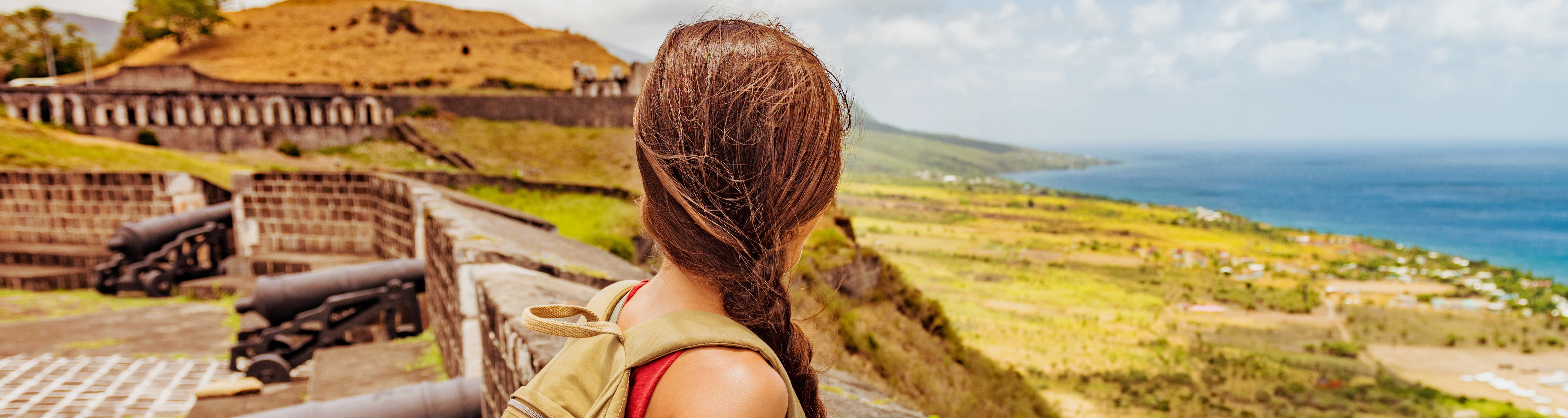
Saint Kitts and Nevis is the smallest sovereign state in the Americas: 261 square kilometres, fewer than fifty thousand people, two volcanic islands separated by a three-kilometre channel. Saint Kitts is shaped like a tennis racquet, with a narrow handle running southeast that holds nearly all the beaches. Nevis, across the water, is an almost perfect cone crowned with cloud.
The essentials in four lines
- Canadian passport valid six months beyond your planned departure date. No tourist visa.
- About five hours of flying, with a connection from Montreal to Robert L. Bradshaw (SKB).
- East Caribbean dollar, US dollars accepted everywhere. English. Driving on the left with a temporary local permit.
- December to April is the dry season. Hurricane season runs from early June to late November.
An island that changed trades
For three and a half centuries Saint Kitts lived on sugar cane. The last harvest came in 2005: the government closed the industry outright, judging it could no longer pay. The fields went back to scrub, the mill chimneys stayed standing, and the island turned to tourism.
One curiosity survives from that era: the railway, built between 1912 and 1926 to carry cane to the central factory. It is the last working railway in the West Indies. Double-decker carriages now circle the north of the island in three hours, on the same rails, across the original gorges and bridges.
Brimstone Hill
Two hundred and thirty metres above the sea, on a volcanic spur, stands the best-preserved fortress in the Caribbean. The British had it built by enslaved Africans over nearly a century from 1690, cutting the volcanic stone on site. It was nicknamed the Gibraltar of the West Indies.
It has been a UNESCO World Heritage site since 1999. From the ramparts on a clear day you take in Nevis, Sint Eustatius, Saba, Saint Barthélemy and Saint Martin in a single sweep.
The beaches, nearly all in the southeast
The peninsula
A scenic road opened in the 1990s serves the handle of the racquet. Cockleshell Bay and Majors Bay look across the channel at Nevis, with flat water and a few beach restaurants. South Friars Bay is the quietest of the three.
Frigate Bay
The main hotel area, with two beaches back to back: the Caribbean side, calm, lined with a row of stilted bars that come alive on Friday evenings, and the Atlantic side, windier, where you walk rather than swim.
The north
Dieppe Bay and the northern coves have dark grey volcanic sand, almost deserted, with an offshore reef that shelters the swimming. Few services, a great deal of quiet.
Nevis, forty-five minutes away
The ferry links Basseterre to Charlestown in three quarters of an hour. Nevis has eleven thousand residents, a 985-metre peak almost always capped in cloud, and Pinney’s Beach, six kilometres of pale sand lined with coconut palms.
It is also an island of history. Alexander Hamilton was born here in 1755; his birthplace houses a small museum. The hot springs at Bath fed an establishment from 1778 that is regarded as the first hotel in the Caribbean; the stone pools are still accessible.
All-inclusive in Saint Kitts
The offering is modest, and it is better to know that. A few hotels at Frigate Bay and on the peninsula sell an all-inclusive plan, often as an option added to the room rate; the international brands on the island mostly sell room-only, with restaurants billed separately.
So the destination suits the traveller who intends to go out, ride the train, climb to Brimstone Hill and cross to Nevis, less the one looking for a full week without leaving the resort. Our criteria for choosing an all-inclusive hotel help do that maths before booking.
When to go
From December to April the air stays around 28 °C, the trade winds blow and rain is scarce. From July to October, heat and humidity climb and the cyclone season peaks.
Three moments animate the calendar: carnival, which runs from late December into early January rather than in February as elsewhere; the music festival in June, over three nights; and Nevis Culturama in late July. To place those windows in Quebec departure pricing, see when to travel south.
Sargassum concerns the Atlantic side, to the east. The peninsula beaches and the Caribbean coast generally stay clear.
Entry requirements, health and safety
A Canadian passport must be valid six months beyond the planned departure date. No tourist visa is required, but customs officers may ask for a return or onward ticket and proof of sufficient funds. To drive, a temporary local permit is issued on the spot for a fee on presentation of your Quebec licence.
No vaccine is mandatory, except proof of yellow fever vaccination if arriving from an affected country. Care is provided by a hospital in Basseterre and another in Charlestown, with evacuation to Puerto Rico or Martinique for serious cases.
For current entry conditions and official recommendations, see the Government of Canada page on Saint Kitts and Nevis.
The monkeys, and the rest
The French brought green monkeys from West Africa in the seventeenth century. Three hundred years later they outnumber the residents and come down from the hills at dawn to raid the orchards. You meet them everywhere, including on the beach; better not to feed them, they remember.
At the table, look for goat water, a long-simmered goat stew served with bread, and saltfish with spicy plantains. On Saturday mornings, the Basseterre market is the best place on the island to understand what people actually eat here.
To plan this trip, see also Nevis, St kitts, our month-by-month calendar and the All-inclusive vacations section.


