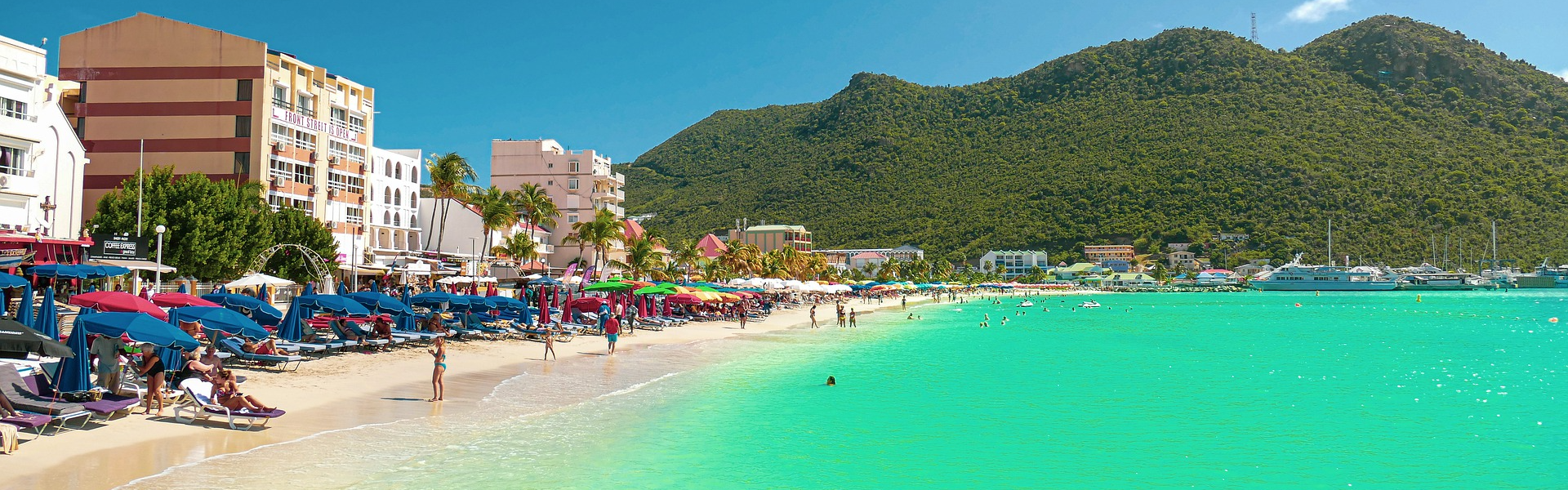

On an island of eighty-eight square kilometres shared between two countries, the real question is not which destination but which beach and which side. Thirty-seven beaches, two towns, one coast road and no border: here is how to organise it in practice.
The essentials in four lines
- About five hours on a seasonal non-stop from Montreal to Princess Juliana (SXM), in the southwest of the island.
- Both sides drive on the right, which sets the island apart from most of its Caribbean neighbours.
- Euros in the north, US dollars in the south, both accepted everywhere. One hour ahead of Montreal in winter.
- A departure tax applies at the airport and on ferry links; it is often already included in the ticket.
The two towns
Marigot
The French administrative centre, on the west coast. A marina, an open-air market on Wednesday and Saturday mornings selling spices, fruit and fish, and the ruins of Fort Louis, built in 1789, overlooking the bay after a fifteen-minute climb. The view reaches Anguilla.
Philipsburg
The Dutch capital, in the south, wedged between the sea and a large salt pond. Two parallel streets hold the duty-free shops, and a wooden boardwalk runs along the beach. On cruise days the area is saturated from nine to four; by late afternoon it goes quiet again.
Which beach for what
For families
Baie Nettlé and Anse Marcel, on the French side, have flat shallow water. Pinel Island, five minutes by shuttle from Cul-de-Sac, is the best day out: sandy bottom, clear water, two beach restaurants.
For water sports
Orient Bay, two kilometres of sand on the east side, with beach clubs, windsurfing and kiteboarding. Its southern end has kept a naturist tradition since the 1970s. It is also the beach most exposed to sargassum in some years.
For quiet
Baie Rouge and Happy Bay, on the west coast, separated by a ten-minute path. Few facilities, few people, sunsets facing Anguilla.
For curiosity
Maho Beach, at the end of the airport runway: aircraft pass over swimmers as they land. Stay clear of jet blast on takeoff, which throws sand and gravel at speed.
For straightforward swimming
Mullet Bay, in the southwest, remains the finest beach on the Dutch side: white sand, turquoise water, a sharp drop-off.
Getting around
A rental car is the simplest answer: driving is on the right, distances are short and the island loop takes ninety minutes without stops. Traffic builds at the entrance to Philipsburg and around the Simpson Bay lift bridge, whose opening times block the road several times a day. Check them; it can cost you twenty minutes.
Taxis work on fixed fares by route and passenger count, in US dollars, and there is no meter.
Excursions by sea
Anguilla is twenty-five minutes by ferry from Marigot. Saint Barthélemy takes forty-five minutes from Oyster Pond or Philipsburg. The uninhabited islet of Tintamarre is visited by catamaran, with its white clay baths. All three are day trips and are booked the day before.
Accommodation and the table
All-inclusive exists mainly on the Dutch side, at a few large beachfront resorts, and at Anse Marcel and Baie Nettlé on the French side. A good share of the hotel stock sells room-only, because the whole island is a restaurant map.
Grand-Case, on the north coast, lines up thirty-odd tables on a single street, and at its end open-air grills where ribs, jerked chicken and fish sell for a fraction of the neighbouring prices. If you plan to eat out three evenings out of seven, do the maths: our criteria for choosing an all-inclusive hotel take up that question.
When to go
From December to April the trade winds blow, the air holds around 28 °C and rain is rare. The island is markedly drier than Saint Lucia or Dominica.
From mid-August to October the cyclone season peaks and some restaurants close. Our guide on when to travel south from Montreal sets out the pricing calendar.
To plan this trip, see also our Saint Martin page and judging value for money.


