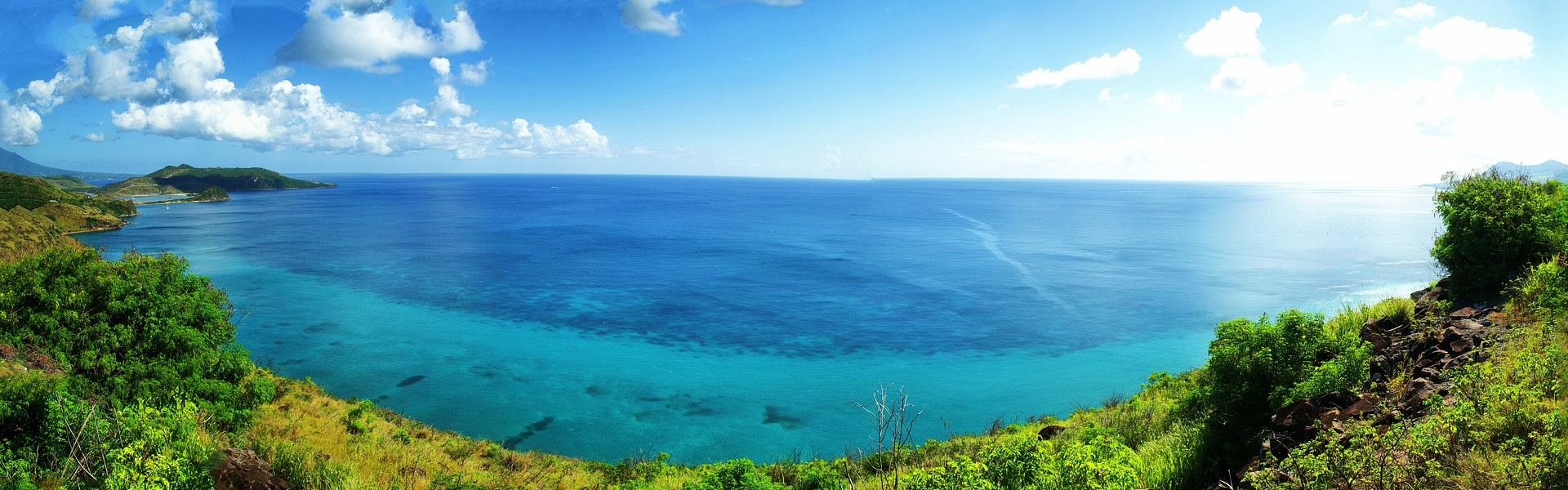
Saint Kitts is visited from a single base, because everything fits on an island you can circle in an hour. The southeast peninsula holds the beaches, the northwest coast the heritage, and Basseterre serves as the hinge. Here is how to organise yourself on the ground.
The essentials in four lines
- Fly into Robert L. Bradshaw (SKB) with a connection from Montreal, fifteen minutes from Basseterre.
- Driving is on the left and a temporary local permit, issued on the spot for a fee, is required.
- East Caribbean dollar, US dollars accepted everywhere. One hour ahead of Montreal in winter.
- The beaches are in the southeast; the north coast has grey volcanic sand and few services.
Where to stay
Frigate Bay
The main hotel area, on the isthmus, with two beaches back to back. On the Caribbean side, calm water and a row of stilted bars that come alive on Friday evenings. On the Atlantic side, more wind and swell: you walk rather than swim. A golf course fills the space between them.
The southeast peninsula
A scenic road opened in the 1990s serves Cockleshell Bay and Majors Bay, which look across the channel at Nevis, along with South Friars Bay, the quietest. Flat water, a few beach restaurants, very little building.
The north
Dieppe Bay and the northern coves have dark grey volcanic sand and are almost deserted, with a reef sheltering the swimming. Few services, a great deal of quiet.
The two visits to make
The railway
Built between 1912 and 1926 to carry sugar cane to the central factory, it is the last working railway in the West Indies. Double-decker carriages circle the north of the island in three hours, on the original rails and bridges, with the sea on one side and fields gone back to scrub on the other. The sugar industry closed outright in 2005; this train is its last rolling witness.
Brimstone Hill
Two hundred and thirty metres above the sea, the best-preserved fortress in the Caribbean, a UNESCO World Heritage site. The British had it built by enslaved Africans over nearly a century from 1690. From the ramparts on a clear day you see Nevis, Sint Eustatius, Saba, Saint Barthélemy and Saint Martin.
The rest
Mount Liamuiga, a dormant volcano of one thousand one hundred and fifty-six metres, is climbed in five hours round trip with a guide, through rainforest and up to the crater rim.
Basseterre is seen in two hours: the Circus with its cast-iron clock, Independence Square, the cathedral and the Saturday morning market. On cruise days the port and the shops are saturated in the middle of the day.
Nevis is reached in forty-five minutes by ferry from Basseterre, or ten minutes by launch from the southern peninsula.
Accommodation
The all-inclusive offering is modest: a few hotels at Frigate Bay and on the peninsula sell it, often as an option added to the room rate. The international brands on the island mostly sell room-only.
So the destination suits the traveller who means to go out, ride the train, climb to Brimstone Hill and cross to Nevis, less the one wanting a full week without leaving the resort. Our criteria for choosing an all-inclusive hotel help with that calculation.
When to go
From December to April the air stays around 28 °C, the trade winds blow and rain is scarce. From July to October, heat and humidity climb and the cyclone season peaks.
A local particularity: the Saint Kitts carnival runs from late December into early January, not in February as elsewhere. The music festival is held in June. Sargassum concerns the Atlantic side; the peninsula and the Caribbean coast generally stay clear. Our guide on when to travel south from Montreal sets out the pricing calendar.
To plan this trip, see also our St Kitts page, Nevis and our month-by-month calendar.


