
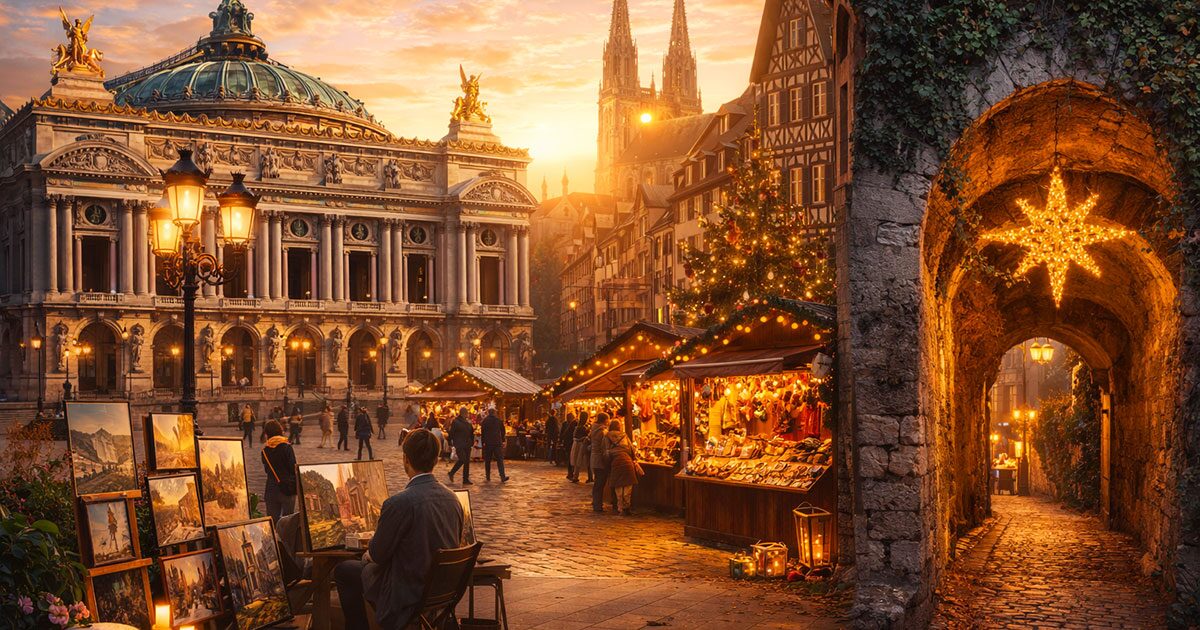
There are travel experiences that have no equivalent in ordinary life. Not monuments or museums — monuments can be photographed, read about, imagined. No, the experiences that have no equivalent are those that engage all the senses at once in a direction you didn’t expect. European Christmas markets are among them. The smell of mulled wine with cinnamon and cloves rising in the cold December air. The sound of bells and carols filtering between half-timbered houses covered in snow. The glow of string lights turning a medieval alley into something you hesitate to call real. And in your hands, a warm cup you don’t want to let go of.
These markets have existed for centuries — Strasbourg has held its market since 1570, Nuremberg since 1628, Vienna since the 14th century. They are not tourist attractions created for the occasion: they are living traditions, moments of the year that locals look forward to just as much as visitors. And that is precisely what makes them extraordinary — you don’t attend them as a show, you take part in them as a collective celebration.
For Quebecers, these markets have a particular appeal. We know winter, we know the cold, we understand what it means to seek warmth and light in the dark season. And when we see a square in Colmar covered in snow, its colorful houses lit by thousands of points of light, its wooden stalls smelling of gingerbread and fir resin — something happens that feels like recognition. It’s not our tradition, but it could be.
In this guide, our AquaTerra advisors present the most beautiful Christmas markets in the world — in Europe first, but also beyond — with everything you need to plan the December trip of your life. → For a complete guide to France and its Alsatian markets, see our article on traveling to Alsace from Quebec.
1. Why European Christmas markets are in a category of their own
The difference photos can’t capture
We think we know European Christmas markets because we’ve seen thousands of photos of them. Photos show the lights, the architecture, the colorful wooden stalls. What they don’t convey is the full sensory dimension — and it’s precisely this dimension that makes people who have been once come back again and again. The smell of Glühwein (spiced mulled wine) rises from copper kettles from 10 meters away. The crunch of snow under your boots. The warmth of roasted chestnuts in your hands. The sound of a children’s choir singing in a cathedral open to the square.
These markets work because they activate all the senses at once in a single direction — celebration, human warmth, simple pleasure. No phone required, no screens, no urgency. Just the square, the crowd, the clean cold of December, and that Advent light that exists nowhere else.
Authenticity that endures
Unlike many tourist traditions that have been standardized by international demand, European Christmas markets resist remarkably well to dilution by mass tourism. The reason is simple: they belong to the locals before they belong to visitors. The stalls in Strasbourg or Nuremberg are occupied by the same artisan families for generations. Recipes for Glühwein, Lebkuchen, and Stollen are local and fiercely protected. The opening ceremonies — the lighting of the lights, the proclamation of the Christkind in Nuremberg, the Christmas blessing in Vienna — are genuine community moments, not performances created for cameras.
2. The most beautiful Christmas markets in the world — complete overview
| Market | Country | Dates 2026 | Atmosphere | What makes it unique |
|---|---|---|---|---|
| Christkindelsmärik — Strasbourg | France | Nov 28 – Dec 31 | Magical, historic | The oldest in France (1570) · Giant Christmas tree at Place Kléber · 300 stalls · illuminated Petite France |
| Colmar Christmas Markets | France | Nov 27 – Dec 30 | Romantic, picturesque | 5 markets in 5 districts · Little Venice under snow · Isenheim Altarpiece · more intimate than Strasbourg |
| Christkindlesmarkt — Nuremberg | Germany | Nov 27 – Dec 24 | Traditional, solemn | Germany’s most famous (1628) · Christkind opening ceremony · Lebkuchen · bratwurst in a bun |
| Vienna Christmas Market | Austria | Nov 13 – Dec 26 | Imperial, musical | In front of the illuminated neo-Gothic City Hall · Wiener Punsch · daily classical concerts · 150 stalls |
| Cologne Christmas Markets | Germany | Nov 23 – Dec 23 | Spectacular, lively | 7 distinct markets across the city · Gothic cathedral backdrop · over 3 million visitors |
| Brussels Christmas Market | Belgium | Nov 28 – Jan 5 | Festive, gastronomic | Winter Wonders — giant ice rink · 200 stalls · Belgian chocolate · hot waffles · Ferris wheel |
| Prague Christmas Markets | Czech Republic | Nov 30 – Jan 5 | Medieval, affordable | Old Town Square under snow · 15th-century astronomical clock · cheaper than Western Europe |
| Copenhagen Julemarked | Denmark | Nov 16 – Dec 23 | Design, hygge | Tivoli Gardens — the most beautiful Christmas amusement park in the world · Scandinavian hygge · mulled wine (gløgg) |
| Edinburgh Christmas Market | Scotland | Nov 16 – Jan 5 | Spectacular, festive | On Princes Street with illuminated castle backdrop · Ferris wheel view · hot whisky |
| Mercatini di Natale — Bolzano | Italy (South Tyrol) | Nov 27 – Jan 6 | Alpine, authentic | German-speaking Italy · most authentic market in Italy · Dolomites view · Tyrolean mulled wine |
| Bruges Christmas Market | Belgium | Nov 29 – Jan 5 | Medieval, romantic | The best-preserved medieval city in the world under Christmas lights · ice rink on the Grand Place |
| Stockholm Julmarknad | Sweden | Nov 29 – Dec 23 | Scandinavian, intimate | Gamla Stan (medieval old town) · glögg and pepparkakor · authentic Nordic atmosphere |
3. Must-see markets — what you really need to know
🇫🇷 Strasbourg — The capital of Christmas
Strasbourg is the absolute reference market — the oldest in France (1570), the largest (300 stalls spread across several squares in the UNESCO-listed historic center), and the only one officially allowed to carry the title “Capital of Christmas.” During the four weeks of Advent, the entire city transforms: 13 distinct markets in different neighborhoods, each with its own theme.
The giant illuminated star on Place Kléber — 13 meters high, visible from everywhere in the city center — is the iconic image of Alsatian Christmas. But what truly makes Strasbourg extraordinary is the density — within a 15-minute walk from the cathedral, you pass through a dozen micro-worlds of Christmas, each with its own smells, artisans, and atmosphere.
- The cathedral district: the heart of the market — wooden stalls with Alsatian specialties, choirs singing at dusk, the illuminated pink sandstone spire
- La Petite France: the 16th-century tanners’ district with half-timbered houses reflected in the Ill River — especially magical under light snowfall
- Place Broglie: the main market with large regional stalls — Bredele, Alsatian wines, foie gras, artisanal gingerbread
- The Children’s Christmas Market (Place Saint-Thomas): dedicated to families — workshops, fairy-tale characters, vintage carousel
- Book your accommodation in Strasbourg 12 to 18 months in advance for December weekends — boutique hotels in the historic center are fully booked months before opening
🇫🇷 Colmar — Little Venice in winter
Colmar is often preferred to Strasbourg by travelers returning to Alsace for a second time — not because it is bigger or more spectacular, but because it is more intimate. Its five themed markets spread across five distinct districts of the old town each have their own personality. And its Little Venice district — colorful half-timbered houses reflected in the Lauch canals, covered with garlands and Christmas trees — creates the most perfect Christmas image in France.
- The Cathedral Square market: the largest, with local gastronomic specialties
- The Dominican Square market: under the 13th-century church — high-end Alsatian arts and crafts
- The Little Venice market (Tanners’ district): the most photographed — decorated boats on the canals, lights reflected in the water
- The Covered Market: regional products from local producers — foie gras, Munster cheese, wines, charcuterie
- The Isenheim Altarpiece at the Unterlinden Museum: one of the greatest works of Western painting, to be seen during your stay
🇩🇪 Nuremberg — Pure tradition
The Christkindlesmarkt in Nuremberg is the most famous Christmas market in Germany and one of the most visited in the world — with around 2 million visitors over four weeks. It has been held since 1628 on the Hauptmarkt (main square) of the old town, beneath the windows of the Gothic Church of Our Lady. Each year, the opening ceremony — the Christkind (the Christ Child, represented by a young woman in a golden robe) proclaims the opening from the church balcony — is broadcast live on German radio and television.
Nuremberg is also the capital of Lebkuchen — soft gingerbread made with almonds and spices, prepared using recipes dating back to the 14th century and protected by a geographical indication (PGI): true Nürnberger Lebkuchen can only be produced in Nuremberg. At the market stalls, decorated Lebkuchen boxes featuring Christmas scenes are among the most beautiful and authentic souvenirs you can bring back.
- The official opening (last Friday of November): if your trip coincides, the ceremony alone is worth the journey — the entire square falls silent during the Christkind’s proclamation
- Zwetschgenmännle (prune figures): handcrafted figurines made from dried prunes and nuts — a 15th-century Nuremberg tradition, sold only at this market
- Nuremberg Bratwurst: small pork sausages grilled over charcoal, served three at a time in a bun with mustard — the must-try specialty
🇦🇹 Vienna — The imperial market
Vienna may be the city that embodies Christmas best in its architecture — the neo-Gothic Rathaus illuminated by thousands of lights, with its market of 150 stalls set in its gardens, creates one of the most spectacular Advent scenes in Europe. But Vienna also has a dozen other markets spread across the city — in front of Schönbrunn Palace, in the Hofburg courtyard, and in medieval squares. Each has its own character.
- Rathausplatz Christkindlmarkt: the largest and most spectacular — 150 stalls, daily classical concerts, ice rink in front of City Hall
- Schönbrunn Palace Christkindlmarkt: in the imperial palace gardens — quieter, more elegant, with views of the golden baroque façade
- Wiener Punsch: Viennese mulled wine — different from Alsatian Glühwein or Scandinavian gløgg, made with spiced punch and rum. Each stall has its secret recipe
- Vienna Opera Balls in December: if your budget allows, attending a Vienna Opera Ball is an incomparable experience — evening gowns and tuxedos in a baroque opera house, waltzing until dawn
🇩🇰 Tivoli Gardens — Scandinavian Christmas
Tivoli Gardens is not strictly a Christmas market — it is the world’s oldest amusement park (1843), transformed each winter into a Scandinavian Christmas experience of a beauty even Disneyland cannot replicate. Six million lights, hundreds of Christmas trees, a frozen lake, illuminated historic rides, and everywhere the smell of gløgg (Scandinavian mulled wine) and æbleskiver (round Danish pancakes served with jam and powdered sugar).
Tivoli embodies the Danish concept of hygge — that inner warmth and coziness around a hot drink that defines Danish winter life. And it does so with a precision and beauty that inspired Walt Disney himself when he visited Copenhagen in 1951 to design Disneyland.
- The 6 million lights: Tivoli’s winter illumination is considered among the most beautiful in the world — walking through the park at dusk is one of the most visually satisfying Christmas experiences
- The Nisse (Danish Christmas elf): children search for small hidden elves throughout the park — a tradition since 1843
- The indoor Christmas market: wooden stalls selling Danish crafts, Scandinavian design, and local specialties
🇧🇪 Bruges — The medieval fairytale
Bruges is the best-preserved medieval city in Northern Europe — its canals, Flemish houses, and 13th-century Gothic belfries have barely changed in 700 years. In December, under Christmas lights, Bruges looks so much like a children’s storybook illustration that it’s hard to believe it isn’t a movie set. Its Grand Place, with its ice rink, illuminated belfry, and wooden stalls, is one of the most perfectly composed Christmas scenes in Europe.
- The Grand Place ice rink: skating at the foot of a 13th-century belfry — one of the most unique Christmas experiences in Europe
- Bruges Belgian chocolate: among the best in the world — Dumon, The Chocolate Line, Depla. In December, shops offer extraordinary seasonal creations
- Belgian Christmas beer: each Belgian brewery releases a Christmas beer — stronger, spiced, often 8–12% alcohol. Bruges pubs serve dozens of varieties
- Day trip to Ghent (30 min): Ghent has a remarkable but lesser-known Christmas market — combining both over 3 days is an excellent plan
🇨🇿 Prague — The affordable Eastern gem
Prague is the revelation for travelers seeking magic without Western Europe prices. The Old Town Square — with its 15th-century astronomical clock, twin-spired Gothic Church of Our Lady before Týn, and surrounding medieval houses — is one of the most spectacular Christmas settings in Europe. And prices are 40–50% lower than in Strasbourg, Vienna, or Bruges for a comparable experience.
- The astronomical clock on the hour: every hour, the apostles parade in the 15th-century clock — in the evening, under market lights, it’s a spectacle even locals still watch
- Trdelník: Czech street pastry — dough wrapped around a spit, grilled over charcoal, coated with sugar and nuts. Warm, crispy, soft. Prague’s street specialty
- Svařák: Czech mulled wine — often served in ceramic mugs you keep as a souvenir (deposit refunded or mug kept)
- Prague budget: a full meal in a decent Czech restaurant costs 15–25 CAD per person. A mug of svařák: 3–4 CAD. Boutique accommodation in the old town: 80–150 CAD per night
4. How to reach Christmas markets from Quebec
| Market destination | Flight from Montreal | Total duration | Recommended strategy |
|---|---|---|---|
| Strasbourg / Colmar (Alsace) | YUL → CDG or FRA, then TGV (1h45) | 9 – 11h total | Paris as a hub: direct flight YUL-CDG + Strasbourg TGV 1h45. Combine with 2–3 days in Paris. |
| Nuremberg (Germany) | YUL → FRA or MUC, then train (1h) | 9 – 11h total | Frankfurt or Munich as a hub. Nuremberg + Bruges combination via TGV/ICE possible. |
| Vienna (Austria) | YUL → VIE (direct Austrian, ~9h) | 9 – 10h total | Direct flight to Vienna or via Frankfurt/Munich. Combine Vienna + Prague (2h train). |
| Brussels / Bruges (Belgium) | YUL → BRU (direct Air Canada/Brussels) | 7 – 8h total | The closest destination from Montreal. Bruges + Brussels + Ghent in 5–6 days. |
| Prague (Czech Republic) | YUL → PRG via CDG, FRA or AMS | 10 – 12h total | Prague + Vienna is the ideal combo (4h train). Most budget-friendly option. |
| Copenhagen (Denmark) | YUL → CPH (seasonal direct SAS) | 8 – 9h total | Copenhagen + Stockholm combo. Tivoli Gardens + Scandinavian markets. |
| Bolzano (South Tyrol, Italy) | YUL → VCE or MXP, then train (3h) | 11 – 13h total | Milan or Venice as a hub. Bolzano + Verona (Christmas market at the foot of the Roman Arena). |
| Edinburgh (Scotland) | YUL → EDI via LHR or seasonal direct | 8 – 10h total | Edinburgh + London combo. Christmas market under the illuminated castle. |
5. Which market fits your profile
| Your profile | Our recommendation |
|---|---|
| 💑 Romantic couple — first European Christmas market | Colmar, Alsace — Little Venice illuminated is the most romantic Christmas image in Europe. Combine with Strasbourg for a richer stay. |
| 👨👩👧👦 Family with children (6–12 years old) | Tivoli Gardens Copenhagen — Scandinavian Christmas in the most beautiful park in the world. Or Nuremberg for historical authenticity and child-friendly traditions. |
| 🎭 Culture and history enthusiast | Nuremberg (15th-century traditions) + Prague (astronomical clock + medieval old town) in a single 7–8 day trip. |
| 💰 Controlled budget, maximum experience | Prague — 40–50% cheaper than Western Europe for an equally extraordinary architectural setting. Combine with Vienna by train (4h). |
| 🍷 Food and wine lover | Alsace (Strasbourg + Colmar) — Alsatian wines, foie gras, Bredele, new sauerkraut in winstubs. The richest culinary experience of European markets. |
| 🏰 Medieval architecture enthusiast | Bruges — the most perfectly preserved medieval city in the world under Christmas lights. Combine with Ghent and Brussels. |
| 🎵 Classical music enthusiast | Vienna — daily classical concerts in the imperial setting of the Rathaus, opera, Christmas ballets. The most musical Christmas in Europe. |
| 🌟 Unique experience — off the beaten path | Bolzano (South Tyrol, Italy) — German-speaking Italy in the Dolomites setting. The most authentic market in Italy, unknown to most travelers. |
| 🎒 Experienced traveler who wants to combine everything | 12-day circuit: Bruges (2d) → Cologne (1d) → Nuremberg (2d) → Salzburg (2d) → Vienna (2d) → Prague (2d) → return. The grand Christmas market tour in a single trip. |
6. When to go and how to plan — the golden rules
Key opening dates to remember
The vast majority of European Christmas markets open in late November (around November 25–28, the first weekend of Advent) and close on December 24, 26 or 31 depending on the city. Some, like Brussels or Prague, extend until January 5 or 6 (Epiphany). Dates vary slightly each year depending on the Advent calendar — always check official dates for your travel year.
- First weekend of Advent (late November): opening of most markets. The least crowded period — atmosphere at its peak, crowds not yet there
- Second and third weeks of December: perfect balance — fully active markets, manageable crowds during weekdays
- December weekends: the most crowded — avoid if you want space and serenity. During weekdays, markets return to a more local atmosphere
- December 22–24: peak of the markets — extraordinary evenings, but hotels fully booked and maximum crowds
- December 26–31: markets that remain open (Strasbourg, Prague, Brussels) regain a nearly local atmosphere — tourists leave, locals return
🗓️ The 12 to 18-month rule
This is the most important rule in this guide — and the most often ignored until it’s too late. Charming accommodations in the historic centers of Strasbourg, Colmar, Nuremberg, Bruges, and Vienna for December weekends are fully booked 12 to 18 months in advance. Not an exaggeration — a documented reality. If you read this article in January and want to go to Colmar in December of the same year, you will still find weekday availability. For a December weekend in Strasbourg with a boutique stay in the old town, booking must be done in January–February of the previous year.
Weekday vs weekend — a decision that changes everything
If your schedule allows, choose weekdays over weekends to visit European markets. The difference is dramatic: on Tuesday and Wednesday evenings in December, you can walk through Colmar or Nuremberg with space, talk with artisans, and take your time tasting without queues. On Sunday afternoons, the same streets can be so crowded you have to push through. And weekday accommodation prices are 30 to 50% lower than weekend rates.
7. Christmas market gastronomy — what you eat and drink
Hot drinks — at the heart of the experience
- Glühwein (Alsace, Germany, Austria): red wine heated with cinnamon, cloves, star anise, and orange zest. The iconic drink of German-speaking markets. Each stall has its secret recipe passed down for generations. Souvenir ceramic mugs are included in the price (deposit system) — €3 to €5
- Wiener Punsch (Vienna): Viennese mulled wine — different from Glühwein, made with punch and rum. Sweeter, stronger, more complex
- Gløgg (Denmark, Sweden, Norway): Scandinavian mulled wine — with almonds and raisins settling at the bottom of the cup. Often served with æbleskiver
- Svařák (Prague): Czech mulled wine — less spiced than Glühwein, often with softer spices and sometimes a dash of slivovitz (plum brandy)
- Belgian hot chocolate (Bruges, Brussels): thick, intense, made from real melted Belgian chocolate bars — nothing like powdered mixes. Widely considered the best hot chocolate in the world
Food specialties by market
- Alsace: Bredele (Christmas cookies — cinnamon shortbread, vanilla stars), artisanal gingerbread, foie gras, Stollen (fruit and almond brioche), Christmas Baeckeoffe
- Germany: Nuremberg Lebkuchen (PGI), Dresden Stollen (the authentic version with marzipan), grilled Bratwurst, Kartoffelpuffer (potato pancakes), Glühwein in collectible mugs
- Austria: Punschkrapfen (Viennese punch cake), Kaiserschmarrn (shredded sweet pancake with plum compote), Maroni (roasted chestnuts), Sachertorte
- Belgium: Liège waffles (warm with caramelized pearl sugar), chocolate truffles, freshly baked speculoos, Belgian Christmas blood sausage
- Czech Republic: Trdelník (chimney cake — see Prague section), Svíčková (braised beef with sour cream sauce), Vánočka (braided Christmas bread)
- Scandinavia: Danish æbleskiver (round pancakes with jam), Swedish pepparkakor (spiced cookies), Julskinka (Christmas ham), Janssons frestelse (Swedish anchovy gratin)
8. Suggested itinerary — the grand market circuit in 10 days
| Days | Stops | What you experience |
|---|---|---|
| J1-2 | Strasbourg (Alsace) | Flight YUL-CDG + TGV Strasbourg (1h45). Evening arrival. Christmas markets at Place Broglie and cathedral at night — first cup of Glühwein. Full Strasbourg day (J2) — Petite France, 13 markets, winstub dinner. |
| J3 | Colmar | Train Strasbourg-Colmar (35 min). Five markets including Little Venice. Unterlinden Museum and Isenheim Altarpiece in the afternoon. Evening lights in Little Venice. |
| J4 | Alsatian village — Riquewihr or Eguisheim | Car rental from Colmar. Riquewihr (most beautiful medieval village) or Eguisheim (Most Beautiful Village of France). Alsace wine tasting. Return Colmar / train to Nuremberg. |
| J5-6 | Nuremberg (Germany) | Train Strasbourg-Nuremberg (3h via ICE). Christkindlesmarkt — Christkind ceremony (J5 evening if first weekend). Lebkuchen tasting. Medieval old town. Bratwurst (J6). Christmas Stollen. |
| J7 | Salzburg (Austria) | Train Nuremberg-Salzburg (2h30). Christmas markets at Domplatz and Residenzplatz with baroque cathedral backdrop. “Silent Night” composed nearby in 1818. |
| J8-9 | Vienna | Train Salzburg-Vienna (2h30). Rathausplatz — largest Vienna market (150 stalls, daily concerts). Schönbrunn (J9 morning). Vienna Opera at night — book months ahead. |
| J10 | Prague and return | Train Vienna-Prague (4h). Old Town Square market — astronomical clock. Trdelník. Flight Prague-Montreal via European hub. |
9. Christmas market budget from Quebec
| Expense category | Comfort budget (7 days/person) | Luxury budget (7 days/person) |
|---|---|---|
| Flight Montreal → Europe (round trip) | $750 – $1,400 | $1,400 – $2,800 |
| Accommodation (6 nights — December) | $900 – $1,600 | $2,000 – $5,000 |
| Transport (TGV, intercity trains) | $200 – $400 | $300 – $600 |
| Meals (restaurants + markets) | $350 – $600 | $700 – $1,600 |
| Glühwein, specialties, mugs (markets) | $80 – $150 | $150 – $350 |
| Cultural entries (museums, opera) | $80 – $180 | $200 – $600 |
| Shopping — crafts, gifts, Lebkuchen | $150 – $400 | $400 – $1,200 |
| Travel insurance | $80 – $150 | $100 – $200 |
| TOTAL estimated per person (7 days) | $2,590 – $4,880 | $5,250 – $12,350 |
Best tips to maximize the experience
- Book your accommodation 12 to 18 months in advance for December weekends in major destinations — savings can reach 40–60% compared to last-minute bookings
- Choose weekdays over weekends: same markets, fewer crowds, hotels 30–50% cheaper
- European Ouigo and Intercity trains are often 3–4 times cheaper than TGV/ICE if booked in advance — plan train travel at the same time as hotels
- Prague is 40–50% cheaper than Western Europe for a comparable experience — include it in your itinerary to balance your budget
- Glühwein mugs: deposits are refunded if you return the mug. But mugs often make great souvenirs — each market has its own with the year engraved
Your questions about Christmas markets from Quebec
What is the best Christmas market for a first visit from Quebec?
Colmar, in Alsace, is our top recommendation for a first visit. It delivers most strongly on its photographic promise — Little Venice illuminated is even more beautiful in reality than in pictures. The town is human-sized (less crowded than Strasbourg), easily accessible from Paris by TGV (3h) or via a direct flight to Strasbourg followed by a 35-minute train ride, and Alsace offers a culinary richness unmatched to complement the visual experience. Strasbourg, just 35 minutes away by train, makes for a natural excursion.
Is it really better to book 12 to 18 months in advance?
For December weekends in major destinations (Strasbourg, Colmar, Nuremberg, Bruges, Vienna), absolutely yes. Boutique hotels in historic centers are fully booked months before market openings. For weekday stays, booking 4 to 6 months in advance is usually sufficient. For Prague, even in December, availability is better than in other major cities — but still book 3 to 4 months in advance for the best options.
Should we worry about the cold at European Christmas markets?
Not for Quebecers — you are among the best prepared in the world for cold weather. European markets in December usually range between -2 and +8°C depending on the city and the year. That’s mild compared to our winters. Dress in layers (thermal base, fleece, waterproof windproof coat), wear comfortable boots for cobblestones (sometimes icy), and a good winter hat. The Glühwein does the rest. Practical tip: mittens instead of gloves — easier to hold your cup.
Are Christmas markets suitable for children?
Yes — and some are designed specifically for families. Tivoli Gardens in Copenhagen is perfect for all ages. Nuremberg has a long tradition of children’s markets (Kinderweihnacht with the Christkind). Strasbourg has its children’s market at Place Saint-Thomas with workshops and vintage carousels. Bruges with its Grand Place ice rink. Prague with its animations and medieval traditions. European Christmas markets work well for children from 4–5 years old — younger than that, crowds and cold can be harder to manage.
Can Christmas markets be combined with destinations outside Europe?
The best Christmas markets outside Europe are found in Quebec City (German Christmas Market at Place de l’Hôtel-de-Ville — a great local discovery), in New York (Bryant Park Winter Village — but a very different experience from the European originals), and in Japan where cities like Sapporo offer markets inspired by Alsatian traditions. But for the authentic original experience, Europe remains unmatched — the copies do not capture the essence.
Christmas markets are waiting for you — with their light, warmth, and unmatched magic
There is a phrase you hear almost every time from travelers returning from their first European Christmas market: “Now I understand why people go back every year.” Not because it’s perfect — December crowds can be overwhelming, the cold bites despite the Glühwein, and hotel prices can be dizzying. But because something happens in those illuminated medieval squares, between those snow-covered half-timbered houses and those stalls that smell of cinnamon and fir, that feels like what we are truly looking for when we travel — not just to see beautiful places, but to feel something we haven’t felt before.
At Voyages AquaTerra, our advisors can organize your Christmas market trip — flights from Montreal, accommodations booked in advance in historic centers, train travel between cities, and tailor-made itineraries based on your preferences. Call us as early as possible — for December, now is the time to start planning.


