There are trips you plan to see monuments. And there are trips you plan to understand something — a culture, a way of doing things, a relationship to time and to the land that no museum visit can really convey. Scotland's distillery trail belongs to the second category. It's not a tourist trip. It's a trip for the curious — to understand how water, barley, peat and time inside an oak cask produce liquids that people all over the world open in the evening knowing they're drinking something irreplaceable.
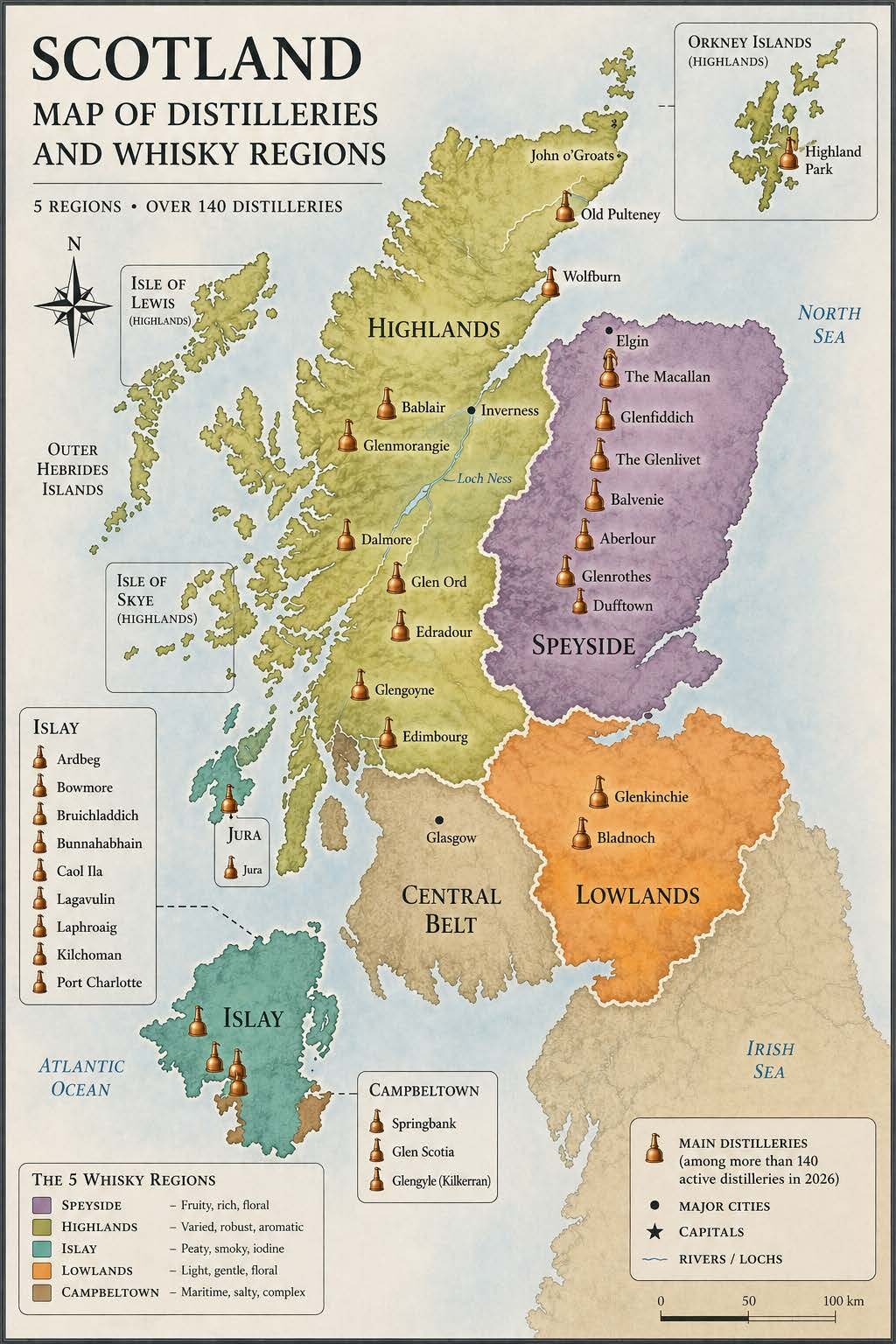
Scotland has more than 140 active distilleries in 2026 — the highest number in its history. From the southern Lowlands to the islands of the Hebrides, each region produces whiskies that reflect the territory where they're made : the peat of Islay in every sip of a Laphroaig, the honey of the Highlands in a Dalmore aged 18 years, the floral lightness of Speyside in a Glenlivet 12 years. Scotch whisky isn't a single, uniform category — it's a continent of flavours, and the distilleries are its cities.
This guide is for Quebec whisky lovers who want to make this trip at least once — with the regions explained, the distilleries to visit, the complete scotch reference table with SAQ availability, the itineraries and everything you need to know from Montreal.
→ For a Scotland trip more broadly (Edinburgh, Highlands, Loch Ness), see our Europe cluster for complete destination information.
1. The 5 whisky regions — a continent of flavours
🌿 Speyside — the highest concentration of distilleries in the world
Speyside is a valley in northeastern Scotland, drained by the river Spey, that on its own concentrates more than 50 distilleries within a corridor of less than 100 km. This is where the world's best-selling whiskies are produced : Glenfiddich, The Glenlivet, The Macallan, Balvenie, Aberlour, Glenrothes. Speyside whiskies share a common profile — fruity, floral, relatively soft, with notes of apple, pear, honey and vanilla that come from aging in sherry or bourbon casks. No peat, generally little smoke. These are the most accessible whiskies for beginners and connoisseurs alike.
The Speyside Trail is a marked 100 km route that links the distilleries on foot or by bike — a former railway line converted into a cycle path runs along the river Spey between Aviemore and Craigellachie. The village of Dufftown (« the whisky capital of the world » according to its welcome sign) is Speyside's centre of gravity, with 7 distilleries within a 5 km radius.
- Iconic distilleries : Glenfiddich (the most visited in the world), The Macallan (the most prestigious), Balvenie (the most artisanal — the only one to keep its own barley fields and traditional malting floor)
- Whisky style : fruity, floral, soft — honey, apple, pear, vanilla, sometimes sherry and chocolate in expressions aged in oloroso casks
- Base for exploration : Aberlour (charming village, good selection of accommodation) or Elgin (larger town, good logistics hub)
⛰️ Highlands — the largest territory, the most varied styles
The Highlands cover most of Scotland north of Glasgow and Edinburgh — a vastness of moors, lochs, glens and coastlines that produces whiskies as different from each other as the territory itself. A Dalmore from the eastern Highlands (rich, spicy, chocolate and orange) has almost nothing in common with an Old Pulteney from the north coast (briny, maritime, lemony) or a Glengoyne from the southern Highlands (unpeated, soft, with notes of nuts and sherry). It's the most diverse region of Scotch whisky.
The northern Highlands — around Inverness and Loch Ness — are the most visited area for combining whisky and landscape. The road to John o'Groats (the northernmost point of Scotland) passes several extraordinary distilleries set in landscapes that justify the trip on their own.
- Iconic distilleries : Dalmore, Glenmorangie, Balblair, Clynelish (north coast), Edradour (the smallest traditional distillery in Scotland), Glengoyne (just outside Glasgow)
- Whisky style : extremely varied depending on the sub-region — from briny maritime to rich sherry, with everything from light floral to moderately peated in between
- Base for exploration : Inverness (direct flights from London, hub for the northern and central Highlands)
🌊 Islay — the island of peat and smoke
Islay (pronounced « eye-luh ») is an island in the Inner Hebrides with 3,600 inhabitants — and 9 active distilleries. It's the most mythical and instantly recognizable whisky region in the world. Islay whiskies are peated — sometimes very heavily peated — which gives them that smoky, briny, maritime, medicinal character that splits humanity into two camps : those who love it and those who flee from it. A Laphroaig Quarter Cask or an Ardbeg 10 years tastes like nothing else in the whisky world — these are tasting experiences as polarizing as they are memorable.
Islay's peat is unusual — it's loaded with marine plants and coastal sphagnum that give it iodine and sea-salt notes absent from inland peats. When the barley is dried with this peat before fermentation, the whisky keeps a signature that survives decades of cask aging. An Ardbeg distilled in 2000 and opened in 2025 still smells of the bay, the kelp and peat smoke.
- Iconic distilleries : Laphroaig (the most peated of the major distilleries), Ardbeg (the cult favourite), Lagavulin (the most balanced of the heavily peated ones), Bowmore (the oldest — 1779), Bruichladdich (the least peated, experimental and innovative), Kilchoman (the youngest — 2005, the only farm distillery on Islay)
- Whisky style : peated, smoky, briny, maritime — with significant variation between distilleries (Bruichladdich is unpeated, Kilchoman is lightly peated, Ardbeg and Laphroaig are very heavily peated)
- Access : CalMac ferry from Kennacraig (Kintyre) — 2 h 10 to Port Ellen or Port Askaig. Or flight from Glasgow (30 min, Loganair). Book the ferry well ahead in high season — vehicle spots are limited
🌾 Lowlands — lightness and finesse
The Scottish Lowlands — the plains south of an imaginary line between Glasgow and Dundee — produce the lightest and most accessible whiskies in Scotland. The Lowland tradition is one of triple distillation (as in Ireland), which yields particularly soft, floral, easy-drinking spirits. The Lowlands suffered a long period of closures during the 20th century but have seen a remarkable revival since the 2000s, with new distilleries in Edinburgh, Glasgow and the surrounding countryside.
- Iconic distilleries : Auchentoshan (triple-distilled, lightly peated, just outside Glasgow), Glenkinchie (Edinburgh's distillery — soft and floral), Bladnoch (Scotland's southernmost, refurbished in 2015), Kingsbarns (new generation — premium distillery and visitor experience near St Andrews)
- Whisky style : light, floral, grassy, sometimes creamy — very accessible for new whisky drinkers
🏴 Campbeltown — the lost city of whisky
Campbeltown, at the tip of the Kintyre peninsula, was once the whisky capital of the world — 34 active distilleries at its peak in the 19th century. Only 3 remain today (Springbank, Glen Scotia, Glengyle), but what's left is among the most authentic and most sought-after in the world. Springbank is the only distillery in Scotland to carry out the entire process — malting, distillation, maturation, bottling — on a single site, with an artisanal approach that makes no concessions to industrial efficiency. Campbeltown whiskies have a briny, slightly oily, lightly peated character that sets them apart immediately.
- Distilleries : Springbank (the most sought-after), Glen Scotia, Glengyle (Kilkerran brand)
- Access : 3 h drive from Glasgow. Isolated village, end-of-the-world atmosphere — exactly what its detractors hold against it and what its devotees love about it
2. The full scotch reference table — with SAQ availability
Column legend : Peat = smoke/peat level out of 5 · CAD price = approximate price at the SAQ or specialty store · SAQ = availability (R = regular, S = specialty, HS = variable out-of-stock)
| Single Malt | Region | Age | Peat | Tasting profile | Food pairing | CAD price | SAQ |
|---|---|---|---|---|---|---|---|
| Glenfiddich 12 years | Speyside | 12 years | 0/5 | Pear, apple, soft oak, light vanilla | Smoked salmon, mild cheeses | $72 | R |
| Glenfiddich 18 years | Speyside | 18 years | 0/5 | Toffee, oak, dried fruit, soft spices | Duck breast, aged cheeses | $140 | R |
| The Glenlivet 12 years | Speyside | 12 years | 0/5 | Floral, pineapple, vanilla, gentle sweetness | Shrimp, sashimi, fresh cheeses | $72 | R |
| The Glenlivet 18 years | Speyside | 18 years | 0/5 | Tropical fruit, spices, white chocolate | Cheese board, dried fruit | $130 | R |
| The Macallan 12 years Sherry | Speyside | 12 years | 0/5 | Raisin, candied orange, ginger, chocolate | Dark chocolate, nuts, figs | $115 | R |
| The Macallan 18 years Sherry | Speyside | 18 years | 0/5 | Intense sherry, dark fruit, cinnamon, fine wood | Foie gras, chocolate desserts | $340 | S |
| Balvenie 14 years Caribbean Cask | Speyside | 14 years | 0/5 | Vanilla, coconut, banana, soft oak | Tropical desserts, crème brûlée | $115 | R |
| Balvenie 21 years PortWood | Speyside | 21 years | 0/5 | Port, red fruit, honey, spices | Terrines, hard cheeses | $295 | S |
| Aberlour 12 years Double Cask | Speyside | 12 years | 0/5 | Honey, baked apple, vanilla, light sherry | Apple pie, aged cheddar | $85 | R |
| Aberlour A'bunadh | Speyside | No age statement | 0/5 | Intense sherry, plum, chocolate, spices | 70 % chocolate, strong cheeses | $125 | S |
| Glenrothes 12 years | Speyside | 12 years | 0/5 | Vanilla, lemon, light spices, floral | Grilled fish, roast chicken | $85 | S |
| Craigellachie 13 years | Speyside | 13 years | 0/5 | Beeswax, pear, light sulphur, herbs | White meats, goat cheeses | $95 | S |
| Dalmore 12 years | Highlands | 12 years | 0/5 | Candied orange, chocolate, nuts, light sherry | Red meats, aged cheeses | $90 | R |
| Dalmore 18 years | Highlands | 18 years | 0/5 | Citrus, oriental spices, intense sherry | Foie gras, cheese board | $250 | S |
| Glenmorangie Original 10 years | Highlands | 10 years | 0/5 | Vanilla, peach, white flowers, butter | Seafood, fish, light desserts | $75 | R |
| Glenmorangie Quinta Ruban 14 years | Highlands | 14 years | 0/5 | Mint, dark chocolate, orange, port | Chocolate, blue cheeses | $105 | R |
| Balblair 12 years | Highlands | 12 years | 0/5 | Red fruit, lemon, caramel, floral | Salmon, risotto, fresh goat cheeses | $95 | S |
| Old Pulteney 12 years | Highlands | 12 years | 1/5 | Light briny, lemon, sea salt, caramel | Seafood, oysters, coastal cheeses | $78 | R |
| Clynelish 14 years | Highlands | 14 years | 1/5 | Wax, citrus, floral, light coastal smoke | Smoked fish, charcuterie | $105 | S |
| Edradour 12 years | Highlands | 12 years | 0/5 | Cream, sherry, apple, hazelnut | Creamy desserts, mild cheeses | $95 | S |
| Glengoyne 12 years | Highlands | 12 years | 0/5 | Green apple, oak, caramel, hazelnut | Charcuterie board, chicken | $88 | R |
| Glengoyne 21 years | Highlands | 21 years | 0/5 | Intense sherry, nuts, orange, warm spices | Game, hard cheeses | $215 | S |
| Laphroaig 10 years | Islay | 10 years | 5/5 | Intense peat, iodine, seaweed, hospital, pepper | Oysters, strong cheeses, dark chocolate | $88 | R |
| Laphroaig Quarter Cask | Islay | No age statement | 5/5 | Dense smoke, vanilla, coconut, iodine | Danish blue, smoked meats | $92 | R |
| Laphroaig Lore | Islay | No age statement | 4/5 | Balanced peat, lemon, honey, soft smoke | Smoked salmon, washed-rind cheeses | $135 | S |
| Ardbeg 10 years | Islay | 10 years | 5/5 | Smoke, lemon, vanilla, tar, pepper | Dark chocolate, strong cheeses, oysters | $88 | R |
| Ardbeg Uigeadail | Islay | No age statement | 4/5 | Sherry, smoke, chocolate, raisin, coffee | Braised meats, blue cheeses | $125 | S |
| Ardbeg An Oa | Islay | No age statement | 3/5 | Soft peat, vanilla, plum, spices | Mixed cheese board, charcuterie | $105 | S |
| Lagavulin 16 years | Islay | 16 years | 5/5 | Deep smoke, peat, sherry, iodine, nuts | Red meats, powerful cheeses | $145 | R |
| Lagavulin 8 years | Islay | 8 years | 4/5 | Sharp smoke, lemon, pepper, light sherry | Oysters, smoked tapas | $95 | S |
| Bowmore 12 years | Islay | 12 years | 3/5 | Flowers, moderate smoke, lemon, vanilla | Gateway to peated whiskies — perfect introduction | $85 | R |
| Bowmore 15 years Darkest | Islay | 15 years | 3/5 | Sherry, chocolate, balanced peat, cherry | Meats, cheese board | $115 | S |
| Bruichladdich Classic Laddie | Islay | No age statement | 0/5 | Floral, cereals, fresh herbs, lemon | Seafood, salads, goat cheeses | $88 | R |
| Bruichladdich Octomore | Islay | No age statement | 5/5 | The most heavily peated in the world — extreme smoke, vanilla | Pure tasting experience | $185 | S |
| Kilchoman Machir Bay | Islay | No age statement | 3/5 | Moderate peat, vanilla, lemon, sea salt | Fish, oysters, coastal cheeses | $95 | S |
| Auchentoshan 12 years | Lowlands | 12 years | 0/5 | Floral, lemon, creamy lightness, soft malt | Sushi, salads, fresh cheeses | $72 | R |
| Auchentoshan American Oak | Lowlands | No age statement | 0/5 | Vanilla, lime, coconut, butter | Shrimp, light Asian cuisine | $65 | R |
| Glenkinchie 12 years | Lowlands | 12 years | 0/5 | Flowers, fresh grass, peach, biscuit | Aperitif, white fish, goat cheeses | $80 | S |
| Bladnoch 10 years | Lowlands | 10 years | 0/5 | Pear, vanilla, floral, light spice | Light cuisine, vol-au-vent, mild cheeses | $85 | S |
| Springbank 10 years | Campbeltown | 10 years | 2/5 | Briny, lightly peated, malt, lemon, herbs | Seafood, salmon, sheep's-milk cheeses | $105 | S |
| Springbank 15 years | Campbeltown | 15 years | 1/5 | Sherry, salt, dried fruit, rare complexity | Meats in sauce, aged cheeses | $185 | HS |
| Glen Scotia 15 years | Campbeltown | 15 years | 1/5 | Briny, vanilla, oak, light coastal smoke | Smoked fish, charcuterie | $110 | S |
3. Distilleries to visit — experiences and bookings
| Distillery | Region | Tour price | What the experience includes |
|---|---|---|---|
| Glenfiddich | Speyside | £15 – £75 | The most visited in Scotland. From standard tour (£15) to personalized blending experience (£75). Outstanding on-site museum. Open 7 days a week. |
| The Macallan Estate | Speyside | £25 – £250 | New visitor centre (2018) — award-winning architecture. Vertical tasting of rare expressions. Book 2 to 4 weeks ahead. |
| Balvenie | Speyside | £30 – £85 | The most artisanal. Restricted guided tour (12 people max). Traditional malting visible. Booking required — fills up months in advance. |
| Aberlour | Speyside | £20 – £60 | Authentic village setting. Tasting directly in the warehouse. Option to fill your own bottle from the cask. The friendliest experience in Speyside. |
| Glenmorangie | Highlands | £20 – £95 | Near Tain, on the north coast of the Highlands. The 16 tallest stills in Scotland (5.14 m). Tour + comparative tasting of finishes (bourbon, port, sauternes). |
| Clynelish + Brora | Highlands | £25 – £180 | A rare historic site — Brora (closed in 1983, reopened in 2021) and Clynelish side by side. For collectors and whisky-history enthusiasts. |
| Edradour | Highlands | £12 – £40 | The smallest traditional distillery in Scotland. The whole process in 3 buildings. 19th-century farmstead atmosphere. Near Pitlochry — perfect for a half-day. |
| Laphroaig | Islay | £10 – £80 | Tour of the peat bog + distillery + warehouse. Friends of Laphroaig program : ownership of a square foot of peat bog (free, symbolic). The peated experience par excellence. |
| Ardbeg | Islay | £15 – £75 | The most cult distillery on Islay. Old Kiln Café acclaimed for its local cuisine. Whisky Day in June — global event for Ardbeg fans. Unique atmosphere. |
| Lagavulin | Islay | £20 – £90 | Tour of the oldest distillery on the south coast of Islay (1816). Tasting overlooking Lagavulin Bay. The most dramatically beautiful tour on Islay — castle ruin in the background. |
| Bowmore | Islay | £15 – £60 | The oldest distillery on Islay (1779). In the village of Bowmore — Scotland's only round village (built so the devil could find no corner to hide in). The coolest warehouses on the island — at sea level. |
| Bruichladdich | Islay | £15 – £100 | The most progressive and most experimental. Passionate, talkative staff. Shop with expressions you won't find anywhere else. Philosophy of full transparency on ingredients. |
| Springbank | Campbeltown | £20 – £120 | Booking required — very limited availability. The most authentic and the most respected by connoisseurs. Shop with rare expressions available only on site. |
4. The suggested itinerary — 10 days Speyside + Islay from Montreal
| Days | Stages | What you do |
|---|---|---|
| D1 | Montreal → Edinburgh | Flight YUL → EDI (via London or Dublin, 9 to 12 h total). Arrival in Edinburgh. Night in the city centre — the Royal Mile, Edinburgh Castle, the Scotch Whisky Experience (interactive whisky museum, £19, $29 CAD). |
| D2 | Edinburgh → Pitlochry (central Highlands) | Drive north (2 h). Stop at Glengoyne (distillery on the doorstep of the Highlands). Lunch in Callander. Arrival in Pitlochry — visit Edradour (the smallest traditional distillery). Night in Pitlochry. |
| D3 | Pitlochry → Speyside (Dufftown / Aberlour) | Drive to Speyside (2 h). Visit Glenfiddich (book ahead). Lunch at the Craigellachie Hotel (legendary whisky bar — 800 references). Visit Aberlour — fill your own bottle from the cask. Night in Aberlour. |
| D4 | Speyside — distilleries day | Morning : The Macallan Estate (architecture + premium tasting — book ahead). Afternoon : Balvenie + adjacent Glenfiddich. Evening : whisky-food pairing dinner at the Dowans Hotel. Night in Speyside. |
| D5 | Speyside → Northern Highlands coast | Drive to Inverness then up the north coast (2 h 30). Visit Glenmorangie (Tain). Optional stop at Clynelish/Brora. Spectacular coastal drive. Night in Inverness or Dornoch. |
| D6 | Inverness → Ferry to Islay | Drive to Kennacraig (3 h 30 from Inverness). CalMac ferry to Port Ellen, Islay (2 h 10). Arrival on the island. Night in Port Ellen or Bowmore. First glass of Lagavulin overlooking the bay. |
| D7 | Islay — south coast (Lagavulin, Ardbeg, Laphroaig) | The most intense day of the itinerary. 3 distilleries within 3 km on foot along the south coast. Morning : Ardbeg (Old Kiln Café + tour). Midday : Lagavulin (castle view + tasting). Afternoon : Laphroaig (peat bog + warehouse tour). Night in Port Ellen. |
| D8 | Islay — Bowmore + Bruichladdich + Kilchoman | Morning : Bowmore (the oldest, the round village). Afternoon : Bruichladdich (the most progressive — exceptional shop). Late afternoon : Kilchoman (the farm distillery — sheep grazing in the barley fields). Night in Bowmore. |
| D9 | Islay → Glasgow → Campbeltown (optional) | Ferry back to Kennacraig. Drive to Glasgow (1 h 30) or to Campbeltown + Springbank (2 h — for the devotees). If Glasgow : Auchentoshan (just outside the city). Night in Glasgow. |
| D10 | Glasgow → return to Montreal | Free morning in Glasgow (Clydeside distillery in the old docks). Flight Glasgow → Montreal via London Heathrow or Dublin. Luggage : bottles bought at the distilleries go in the hold — pack them inside clothes or buy the protective sleeves sold at the distilleries. |
5. Practical tips for the whisky traveller
🚗 Getting around — a car is essential
Unlike other circuits in Europe, Scotland's distillery trail must be done by car. The distilleries are scattered across countryside with no public transport. The car also lets you stop spontaneously for a view over a loch or a sheep farm — and that freedom is precisely what makes this trip extraordinary.
- Car rental : book from Canada through a platform like Rentalcars.com or Hertz.ca. Driving is on the left — plan for half a day to adjust. The roads in the Highlands and on Islay are often single-track roads (one lane with passing places) — drive carefully and let others pass.
- Drink-driving : the legal limit in Scotland is 50 mg/100 ml of blood (stricter than in France or Quebec). On distillery days, designate a driver or use the tasting spittoons — sample pours are small but they add up over a day of several distilleries.
- GPS in Scotland : download Google Maps offline — some areas in the Highlands and on Islay have limited connectivity. Scottish postcodes are very precise and work well in GPS systems.
🏨 Where to sleep — the addresses that are part of the trip
- Craigellachie Hotel (Speyside) : the most legendary whisky bar in Scotland — 800 references, expert staff, Victorian lodge atmosphere. Room : £150 to £280. Book 2 to 3 months ahead.
- Gleneagles Hotel (Perthshire) : the Scottish grand hotel. Outstanding whisky bar, spa, golf. For nights when the budget allows. Room : £450 to £900.
- Distillery B&Bs : several distilleries have their own cottages or guesthouses on the estate — Springbank, Bruichladdich, Kilchoman. The most immersive experience — waking up inside the distillery.
- Port Charlotte Hotel (Islay) : the best hotel on the island. Exceptional bar with every Islay expression. View over Loch Indaal. Room : £130 to £220.
📦 Bringing bottles home — the rules for Quebec
- Customs allowance : you can bring back 1.14 litres of alcohol per person duty-free (above that, you pay Canadian provincial and federal taxes). In practice, the rule of 48 hours outside Canada + a stay of more than 7 days allows up to 1.14 L per person.
- Bottles in checked baggage : wrap each bottle in several layers of clothing or use the protective sleeves sold in distillery shops (£3 to £5). Specific bubble-wrap bags for transporting bottles are available online before you leave.
- Expressions you can't find in Quebec : certain expressions bought directly at the distillery (Balvenie, Springbank, Bruichladdich exclusives) aren't available at the SAQ. These bottles often turn out to be the most precious souvenirs of the trip — and the only ones your friends won't be able to match.
- Recording valuable bottles : for high-value bottles (£150 and up), photograph the receipt and keep the invoice — useful for any customs question and for travel insurance.
6. Budget — distillery trail from Quebec
| Expense | Comfort budget (10 d/person) | Premium budget (10 d/person) |
|---|---|---|
| Flight Montreal → Edinburgh (return) | $900 – $1,400 | $1,400 – $2,800 (Business) |
| Car rental (10 days) | $450 – $700 | $700 – $1,200 (premium vehicle) |
| Accommodation (9 nights) | $1,200 – $2,000 | $2,500 – $5,500 (boutique hotels) |
| Distillery tours (10 to 15 visits) | $250 – $450 | $500 – $900 (premium experiences) |
| Meals (local restaurants, pubs) | $600 – $900 | $1,000 – $1,800 |
| Islay ferry (vehicle return) | $150 – $200 | $150 – $200 |
| Bottle purchases at distilleries | $300 – $800 | $800 – $3,000 |
| Travel insurance | $100 – $200 | $150 – $300 |
| ESTIMATED TOTAL per person (10 days) | $3,950 – $6,650 | $7,200 – $15,700 |
Your questions about the distillery trail
Do you have to be a whisky expert to make this trip?
Absolutely not — and this might be what Scottish distilleries do best : welcoming the curious as much as the connoisseurs. Standard tours are designed for beginners — guides start by explaining the basics (malt, distillation, maturation) before moving on to tasting. You'll come away with a working understanding of whisky that no book can deliver as effectively. If you're a beginner, start with Glenfiddich (the most pedagogical), then Bowmore (the perfect introduction to Islay's peated whiskies) before venturing toward Ardbeg or Laphroaig.
What's the best time to do the distillery trail?
May to September is the ideal period — days are very long (up to 18 hours of daylight in Scotland in June), weather is at its mildest (the distilleries sit in beautiful landscapes whatever the weather — but Scottish rain is a reality you have to accept), and all distilleries are open with their full schedules. June is particularly recommended — it coincides with Feis Ìle (Islay's annual whisky festival, the first week of June) with exclusive open days, limited editions and a festive atmosphere around every distillery. Book a year ahead if you're aiming for Feis Ìle.
Can you do Feis Ìle (the Islay festival) from Quebec?
Yes — and it's the most intense experience in the whisky world. Feis Ìle takes place each year during the first week of June on Islay. Each distillery hosts its own open day with exclusive expressions available only that day, tours of areas usually closed to the public, and local festivities. Accommodation on the island fills up 6 to 12 months ahead for this period. Book the ferry, the accommodation and the Feis Ìle tickets as early as January for a June trip.
Which scotches can you find at the SAQ to get started before the trip?
For a gradual initiation before you leave : start with a Glenlivet 12 years or a Glenfiddich 12 years (fruity, soft, accessible — under $75 CAD). Move on to an Aberlour 12 years or a Glenmorangie Original (more complexity, sherry and vanilla notes). To discover peated whiskies without being overwhelmed, the Bowmore 12 years is the best entry point (moderate peat, floral notes that balance the smoke). And if you're ready for the full experience : a Lagavulin 16 years will tell you immediately whether Islay is for you.
Scotland is meant to be drunk as much as it's meant to be seen.
There are trips that change you through what you see. Scotland's distillery trail changes you through what you understand. Understanding that a whisky aged 18 years in a warehouse beside an Islay loch has absorbed something of that place — sea air, peat, the cold damp of the Hebrides — for nearly two decades. Understanding that the people who make this whisky work in the same buildings, with the same processes, as their great-grandparents. Understanding that time, in Scotland, is also measured in cask years.
At Voyages AquaTerra, our advisors can organize your distillery trail from Montreal — flights, car rental, accommodation at the addresses that are part of the journey, and bookings at the most in-demand distilleries. Call us.